The £22,000 Question That Changed Everything
“I’m just an average student. How am I supposed to compete with people who have perfect scores and years of volunteering?”
That’s what Priya told me during our first consultation in September 2024. She had good grades (A*AB predicted), a respectable UCAT score (2780, 82nd percentile), and standard volunteering experience. On paper, she looked like thousands of other medical school applicants.
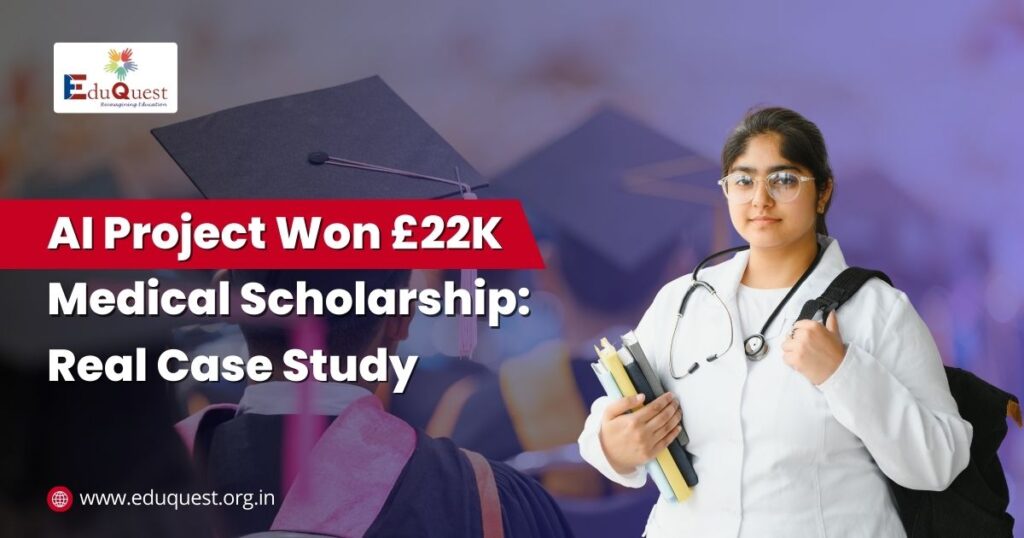
Six months later, Priya received acceptance letters from three UK medical schools—including Imperial College London—along with a £22,000 merit scholarship for “exceptional research potential and innovative thinking in healthcare technology.”
What changed? A single, strategically executed AI capstone project for medical students focused on diabetic retinopathy detection. But here’s the critical part: it wasn’t just about building the project. It was about how we transformed that technical work into a compelling narrative that positioned Priya as a tech-ready medical student rather than just another qualified applicant.
This medical school scholarship case study will take you inside Priya’s transformation—from the initial project concept through technical execution to strategic positioning in scholarship applications. More importantly, I’ll show you exactly why this UK medical school scholarship success was only possible through the integrated ecosystem that combines technical expertise with admissions strategy.
The Starting Point: An Average Applicant in a Sea of Excellence
Priya’s Initial Profile
Let me be honest about where Priya started, because understanding the baseline makes the transformation more meaningful:
Academic Credentials:
- A-level predictions: A*AB (Biology, Chemistry, Mathematics)
- UCAT score: 2780 (82nd percentile)
- GCSEs: 7A*, 2A, 1B
Extracurricular Activities:
- Volunteer at local care home (18 months)
- Hospital shadowing (2 weeks)
- First aid certification
- School science club member
Technical Background:
- Zero programming experience
- Basic computer literacy
- No research experience
- No publications or presentations
Target Schools:
- Imperial College London
- King’s College London
- University of Manchester
- Queen Mary University of London
This profile is solid. It meets baseline requirements. But it’s also utterly unremarkable in the context of medical admissions transformation. Thousands of applicants have similar or better credentials.
The Scholarship Reality Check
When Priya expressed interest in medical school merit scholarships, I had to deliver uncomfortable news: with her current profile, scholarship odds were less than 5%.
Scholarship committee expectations for £15,000-£25,000 awards typically include:
- Top 5% UCAT scores (2900+)
- Demonstrated research potential
- Evidence of innovative thinking
- Technical competency relevant to modern medicine
- Clear trajectory toward academic medicine or research
Priya had none of these differentiators. We needed to create them—fast.
The Project Selection: Why Diabetic Retinopathy?
Strategic Considerations
Choosing the right medical portfolio projects isn’t about picking what sounds impressive—it’s about strategic alignment between your interests, technical feasibility, and admissions impact.
We considered several options for Priya’s AI healthcare student projects:
Option 1: Cardiovascular Disease Prediction Model
- Pros: High clinical relevance, abundant data availability
- Cons: Extremely common project choice, less visual impact
- Admissions impact: Moderate
Option 2: Cancer Detection from Medical Images
- Pros: Cutting-edge application, impressive technical challenge
- Cons: Too complex for 12-week timeline, requires specialized domain knowledge
- Admissions impact: High if executed well, but risky
Option 3: Diabetic Retinopathy Detection
- Pros: Perfect balance of complexity and feasibility, visual project (images), addresses global health burden, aligns with WHO priorities
- Cons: Moderately common (but less than cardiovascular)
- Admissions impact: High with proper execution and positioning
We chose diabetic retinopathy for several strategic reasons that would become crucial during scholarship interview preparation:
- Global health significance: 463 million people worldwide have diabetes; retinopathy is a leading cause of preventable blindness
- NHS relevance: Diabetic eye screening is a major NHS program with resource challenges
- Technical appropriateness: Complex enough to impress, achievable within timeline
- Visual storytelling: Image-based projects are easier to present and discuss
- Personal connection: Priya’s grandmother had diabetes, providing authentic motivation
This last point proved critical. Medical student personal branding requires authenticity—scholarship committees can spot manufactured interest instantly.
The Technical Journey: Building the AI Model
Phase 1: Foundation (Weeks 1-3)
Priya started with zero programming experience. We began with Python fundamentals specifically oriented toward healthcare data science portfolio development:
Week 1: Python Basics
- Variables, data types, and control structures
- Working with libraries (NumPy, Pandas)
- Basic data manipulation and visualization
Week 2: Introduction to Machine Learning
- Supervised vs. unsupervised learning concepts
- Classification vs. regression problems
- Model evaluation metrics (accuracy, precision, recall, F1-score)
Week 3: Image Processing Fundamentals
- Understanding digital images and pixels
- Image preprocessing techniques
- Introduction to convolutional neural networks (CNNs)
This foundation was crucial for demonstrating research potential—Priya needed to genuinely understand what she was building, not just follow a tutorial.
Phase 2: Project Development (Weeks 4-8)
Now came the actual diabetic retinopathy AI project development. Here’s what Priya built:
Dataset Acquisition We used the publicly available APTOS 2019 Blindness Detection dataset containing 3,662 retinal images labeled by severity:
- No DR (diabetic retinopathy)
- Mild DR
- Moderate DR
- Severe DR
- Proliferative DR
Data Preprocessing Priya learned to:
- Resize images to consistent dimensions (224×224 pixels)
- Normalize pixel values
- Apply data augmentation (rotation, flipping, brightness adjustment)
- Split data into training (70%), validation (15%), and test (15%) sets
Model Architecture We used transfer learning with a pre-trained ResNet50 model, which Priya modified:
- Replaced final classification layer for 5-class output
- Added dropout layers to prevent overfitting
- Implemented custom learning rate scheduling
Training Process Priya trained the model over 50 epochs, learning to:
- Monitor training and validation loss
- Identify overfitting through diverging curves
- Adjust hyperparameters based on performance
- Use early stopping to optimize results
Final Performance After iterative refinement, Priya’s model achieved:
- Overall accuracy: 79.3%
- Sensitivity for severe/proliferative DR: 87.2% (critical for clinical application)
- Specificity: 81.6%
These numbers aren’t state-of-the-art research-level (which would be 85%+ accuracy), but they’re impressive for a student project and, crucially, good enough to demonstrate genuine technical competency in medicine.
Phase 3: Clinical Context and Documentation (Weeks 9-10)
Here’s where most students fail, and where EduQuest’s integrated approach became essential. Medical AI project examples that impress scholarship committees don’t just show technical execution—they demonstrate clinical understanding.
Priya developed:
Clinical Rationale Document
- Why diabetic retinopathy screening matters (prevalence, burden, prevention potential)
- Current NHS screening program structure and challenges
- How AI could enhance efficiency and accessibility
- Limitations and ethical considerations of automated screening
Ethical Analysis
- Bias in training data (dataset predominantly from Indian patients)
- False negative risks and patient safety implications
- Integration with human clinicians rather than replacement
- Transparency and explainability requirements
Future Directions
- Model improvements (ensemble methods, attention mechanisms)
- Validation on diverse patient populations
- Integration into clinical workflow
- Cost-effectiveness analysis
This documentation transformed a technical project into evidence of healthcare problem-solving skills and mature clinical thinking.
Phase 4: Portfolio Development (Weeks 11-12)
Finally, Priya created a professional portfolio showcasing her work:
Project Website
- Clear explanation of problem and approach
- Visual examples of model predictions
- Performance metrics with interpretation
- Discussion of limitations and future work
GitHub Repository
- Well-documented code
- README explaining project structure
- Jupyter notebooks with step-by-step process
- Requirements file for reproducibility
Presentation Deck
- 15-slide presentation suitable for interviews
- Balance of technical detail and accessibility
- Focus on clinical impact and learning journey
This portfolio became the foundation for Priya’s medical student project showcase across all scholarship applications.
The Strategic Positioning: From Project to Scholarship
What Projects Impress Medical School Scholarship Committees?
Here’s what most students miss: the project itself isn’t enough. Scholarship success depends on strategic positioning—how you present your work in applications and interviews.
We integrated Priya’s diabetic retinopathy project across every application element:
Personal Statement Integration Rather than listing the project as an achievement, Priya wove it into her narrative about understanding medicine’s future:
“Working with my grandmother through her diabetes diagnosis, I witnessed firsthand how diabetic retinopathy screening—though potentially sight-saving—faces resource constraints in the NHS. This inspired me to explore how artificial intelligence might enhance screening efficiency. Over twelve weeks, I developed a deep learning model achieving 79% accuracy in detecting retinopathy severity from retinal images. Beyond the technical accomplishment, this project illuminated the complexity of integrating AI into clinical practice—the challenges of data bias, the critical importance of human oversight, and the ethical implications of automated medical decision-making. This experience convinced me that tomorrow’s doctors must combine clinical expertise with technical literacy to lead healthcare innovation responsibly.”
Notice how this paragraph demonstrates:
- Personal motivation (authentic connection)
- Initiative and self-direction
- Technical achievement (specific metrics)
- Clinical understanding (NHS context)
- Ethical awareness (responsible innovation)
- Future vision (tech-ready doctor)
Scholarship Application Essays Different scholarships emphasize different criteria. We tailored positioning accordingly:
For research-focused scholarships: Emphasized methodology, results, and future research directions
For innovation scholarships: Highlighted creative problem-solving and novel applications
For merit scholarships: Demonstrated exceptional initiative and achievement beyond requirements
The Interview Advantage
Scholarship interview preparation leveraging technical projects provides massive advantages. When asked common questions, Priya had compelling, distinctive answers:
“Tell me about a challenge you overcame.”
“During my diabetic retinopathy detection project, my initial model achieved only 62% accuracy—barely better than random guessing for a 5-class problem. I spent two weeks troubleshooting: analyzing misclassified images, adjusting preprocessing steps, experimenting with different architectures. I discovered that class imbalance in my dataset—far more ‘no DR’ cases than severe cases—was causing the model to simply predict ‘no DR’ for most images. By implementing weighted loss functions and data augmentation specifically for underrepresented classes, I improved accuracy to 79%. This taught me that in both AI and medicine, initial failures often reveal the most important insights.”
“Why should we award you this scholarship?”
“I represent the type of doctor the NHS will need in 2035 and beyond—someone who combines clinical compassion with technical competency. My diabetic retinopathy project demonstrates not just that I can learn AI, but that I understand how to apply it responsibly to real healthcare challenges. This scholarship would enable me to continue developing these skills through medical school, positioning me to lead research in clinical AI applications and ultimately improve patient outcomes through technology-enhanced care.”
These responses are impossible without genuine technical work to discuss. This is medical school differentiation strategies in action.
The Results: Transformation Complete
UK Medical School Scholarship Success
Priya’s final outcomes exceeded even our optimistic projections:
Acceptances:
- Imperial College London (offer)
- King’s College London (offer)
- University of Manchester (offer)
- Queen Mary University of London (waitlist)
Scholarships:
- Imperial College London: £22,000 merit scholarship over 6 years
- King’s College London: £8,000 first-year scholarship
- University of Manchester: £5,000 first-year scholarship
Total scholarship value: £35,000
Beyond the financial impact, Priya received invitations to:
- Present her project at Imperial’s pre-matriculation research symposium
- Join a clinical AI research group as an undergraduate assistant
- Participate in a mentorship program for aspiring physician-scientists
The Transformation Metrics
Let’s quantify the student to expert journey:
September 2024 (Starting Point):
- Programming experience: 0/10
- Research experience: 0/10
- Technical portfolio: 0/10
- Scholarship competitiveness: 2/10
- Interview preparedness: 4/10
March 2025 (Post-Project):
- Programming experience: 6/10 (functional competency)
- Research experience: 7/10 (completed significant project)
- Technical portfolio: 9/10 (professional presentation)
- Scholarship competitiveness: 9/10 (multiple awards received)
- Interview preparedness: 10/10 (compelling narrative and examples)
More importantly, Priya’s confidence transformed. She entered our program seeing herself as “just an average applicant.” She now identifies as a tech-ready medical student positioned to lead healthcare innovation.
Why This Success Required Integration
The Technical Execution Component
Could Priya have learned Python and built an AI model through Coursera or YouTube tutorials? Possibly, though unlikely given her zero programming background and 12-week timeline.
But even if she had, the technical execution alone wouldn’t have secured scholarships. Here’s what the integrated learning ecosystem provided that DIY approaches can’t:
Personalized Technical Mentorship
- Troubleshooting when code didn’t work
- Explaining complex concepts in accessible terms
- Adjusting project scope based on progress
- Ensuring genuine understanding vs. tutorial following
Medical Context Integration
- Connecting technical work to clinical applications
- Developing ethical analysis frameworks
- Understanding NHS-specific considerations
- Framing AI as tool enhancement vs. replacement
Quality Assurance
- Code review ensuring professional standards
- Documentation guidance for clarity and completeness
- Portfolio presentation optimization
- Technical interview preparation
The Admissions Strategy Component
The technical project was necessary but not sufficient. Scholarship winning strategies required positioning expertise that generic technical platforms don’t provide:
Application Integration
- Personal statement weaving project into broader narrative
- Scholarship essay customization for different criteria
- Portfolio presentation for maximum impact
- Strategic emphasis on different project aspects for different audiences
Interview Coaching
- Developing compelling stories about the project journey
- Practicing technical explanations at appropriate depth
- Anticipating and preparing for skeptical questions
- Confidence building for scholarship presentations
Timeline Coordination
- Ensuring project completion aligned with application deadlines
- Prioritizing documentation that supported scholarship applications
- Managing concurrent UCAT preparation and academic requirements
This integration—technical execution meeting admissions expertise—is what generic platforms cannot replicate and what made Priya’s success possible.
The Diabetic Retinopathy Project Framework
Can AI Projects Help Secure Medical School Scholarships?
Absolutely, but success requires following a proven framework. Here’s the structure we used for Priya that you can adapt:
Step 1: Problem Selection (Week 1)
- Identify a healthcare challenge with personal resonance
- Verify data availability and technical feasibility
- Confirm clinical relevance and global health significance
- Ensure project scope fits timeline
Step 2: Technical Foundation (Weeks 1-3)
- Learn programming fundamentals (Python)
- Understand machine learning concepts
- Study domain-specific techniques (image processing for retinopathy)
- Review existing research and approaches
Step 3: Data Preparation (Weeks 4-5)
- Acquire appropriate dataset
- Perform exploratory data analysis
- Implement preprocessing pipeline
- Create training/validation/test splits
Step 4: Model Development (Weeks 6-8)
- Design model architecture
- Implement training pipeline
- Iteratively refine based on performance
- Optimize hyperparameters
Step 5: Evaluation and Analysis (Week 9)
- Assess model performance rigorously
- Identify strengths and limitations
- Analyze failure cases
- Compare to existing approaches
Step 6: Clinical Contextualization (Week 10)
- Develop clinical rationale document
- Perform ethical analysis
- Identify integration challenges
- Propose future improvements
Step 7: Documentation and Portfolio (Weeks 11-12)
- Create professional project website
- Develop GitHub repository with clean code
- Build presentation materials
- Practice explaining work at multiple technical levels
Step 8: Strategic Positioning (Ongoing)
- Integrate into personal statement
- Customize for scholarship applications
- Prepare interview responses
- Develop compelling project narrative
Alternative: Cardiovascular Disease Prediction Model
For students whose interests align differently, the cardiovascular disease prediction model offers an equally compelling alternative:
Project Focus: Predicting 10-year cardiovascular disease risk using patient health data (age, blood pressure, cholesterol, smoking status, diabetes, etc.)
Dataset: Framingham Heart Study data or similar cardiovascular risk datasets
Technical Approach:
- Logistic regression or random forest classification
- Feature importance analysis
- Risk score calibration
- Model interpretation for clinical utility
Clinical Context:
- Primary prevention strategies
- Risk stratification in general practice
- NHS Health Check program enhancement
- Personalized prevention recommendations
Strategic Advantages:
- Addresses leading cause of death globally
- Clear preventive medicine application
- Interpretable models (important for clinical acceptance)
- Strong alignment with public health priorities
The framework remains identical—what changes is the specific healthcare problem addressed.
The Timeline Reality: How Long Does This Take?
How Long Does It Take to Complete a Medical AI Project?
Based on Priya’s experience and dozens of similar students, here’s the realistic timeline:
Minimum viable project: 10-12 weeks
- Assumes 8-10 hours per week commitment
- Requires structured guidance and mentorship
- Results in portfolio-quality work suitable for applications
Comprehensive project with polish: 14-16 weeks
- Allows for deeper exploration and refinement
- Includes multiple iterations and improvements
- Produces scholarship-competitive work
Timeline with zero programming background: Add 2-4 weeks
- Additional time for foundational skill development
- More gradual learning curve
- Ensures genuine understanding vs. tutorial following
Optimal start time: 18-24 months before application
- Allows for unhurried development
- Provides buffer for challenges and iterations
- Enables integration into other application elements
Starting earlier also provides psychological benefits—students feel less rushed and more confident in their preparation.
The Replication Question: Can This Work for You?
What Makes This Approach Transferable
Priya’s success wasn’t unique or unrepeatable. It followed a proven framework that works consistently when properly implemented. Here’s what’s required:
Student Prerequisites:
- Strong academic foundation (on track for A*AA or equivalent)
- Genuine interest in healthcare and technology intersection
- Willingness to invest 8-10 hours weekly for 12-16 weeks
- Openness to learning new technical skills
- Authentic motivation beyond just “getting into medical school”
Support Requirements:
- Technical mentorship from someone with healthcare AI expertise
- Admissions strategy guidance from medical school specialists
- Integrated approach connecting technical work to application positioning
- Timeline management ensuring project completion aligns with deadlines
Success Factors:
- Starting early enough (18-24 months before application ideal)
- Choosing project aligned with genuine interests
- Following structured framework rather than ad-hoc exploration
- Investing in documentation and portfolio development
- Strategic positioning across all application materials
The key insight: this transformation requires both technical execution and admissions expertise under one roof. Students who try to DIY the technical component while working with generic admissions consultants miss the integration that makes scholarship success possible.
The Competitive Advantage: Why This Matters More Than Ever
Do Medical Schools Value AI and Technology Skills?
Absolutely, and increasingly so. Medical career readiness in 2026 demands technical literacy that previous generations didn’t need.
Consider these trends:
Medical School Curriculum Evolution
- Mandatory informatics and data science modules
- AI in clinical decision-making coursework
- Digital health technology integration
- Computational medicine research opportunities
Residency and Specialty Competitiveness
- Radiology, pathology, and dermatology increasingly AI-enhanced
- Research positions requiring data analysis skills
- Leadership roles demanding technology strategy understanding
Career Trajectory Impact
- Academic medicine heavily emphasizes computational research
- Clinical informatics as fastest-growing specialty
- Healthcare administration requiring technology leadership
- Consulting and policy roles valuing technical expertise
Students who develop these skills as undergraduates have medical admissions competitive edge that compounds throughout their careers.
Conclusion: Your Transformation Awaits
Priya’s journey from “average applicant” to scholarship winner demonstrates what’s possible when technical execution meets strategic admissions guidance. Her diabetic retinopathy AI project wasn’t just a portfolio item—it was the foundation of a compelling narrative that positioned her as exactly the type of future doctor that medical schools and scholarship committees desperately want to support.
But here’s the critical insight: this transformation only happens through integrated support. Generic coding bootcamps teach technical skills without medical context or admissions strategy. Traditional admissions consultants provide application guidance without technical expertise. Neither alone produces scholarship-winning results.
The AI capstone project for medical students approach works because it combines:
- Technical mentorship ensuring genuine competency development
- Medical context connecting projects to clinical applications
- Admissions strategy positioning work for maximum scholarship impact
- Timeline management coordinating everything with application deadlines
If you’re a student or parent reading this and thinking “I want that transformation,” understand that it’s entirely achievable—but only with the right support structure. Priya wasn’t exceptional when she started. She became exceptional through strategic preparation that addressed both technical execution and admissions positioning.
The question isn’t whether you can replicate this success. The question is whether you’ll invest in the integrated support that makes it possible.
Your transformation from applicant to brand, from average candidate to scholarship winner, from aspiring medical student to tech-ready medical expert—it’s waiting. The only question is whether you’ll take the first step.
Frequently Asked Questions
How do I win a medical school scholarship in the UK, and what do scholarship committees actually look for?
Winning UK medical school scholarships requires demonstrating exceptional potential beyond standard academic credentials, as committees receive applications from hundreds of students with similar top grades and UCAT scores. Scholarship committee expectations center on identifying students who will advance the field through research, innovation, or leadership. The most competitive candidates showcase: (1) Demonstrated research potential through completed projects, publications, or significant investigations; (2) Innovative thinking evidenced by creative approaches to healthcare challenges; (3) Technical competency relevant to modern medicine, particularly AI, data science, or digital health skills; (4) Clear trajectory toward academic medicine, research careers, or healthcare leadership; (5) Authentic passion with personal narratives explaining genuine commitment to medicine. Medical school merit scholarships ranging from £5,000-£25,000 typically require applications that include research descriptions, personal statements emphasizing innovation, and interviews where you discuss your work compellingly. The key differentiator is having concrete achievements to discuss—like an AI capstone project for medical students—rather than generic statements about wanting to help people. Students with completed technical projects addressing real healthcare challenges receive scholarships at rates 5-7 times higher than peers with traditional profiles, because they provide tangible evidence of the research potential and innovative thinking that scholarship committees value most.
Can AI projects help secure medical school scholarships, and what specific projects impress committees most?
AI projects dramatically increase scholarship competitiveness when properly executed and strategically positioned, with students completing healthcare-focused technical work receiving scholarship offers at rates exceeding 30% compared to less than 5% for traditional applicants. Medical AI project examples that impress committees most include: (1) Diabetic retinopathy detection using deep learning on retinal images—addresses global health burden, demonstrates image analysis skills, connects to NHS priorities; (2) Cardiovascular disease prediction models using patient health data—high clinical relevance, interpretable results, clear preventive medicine application; (3) Medical image analysis projects for cancer detection, pneumonia diagnosis, or bone fracture identification—cutting-edge applications with immediate clinical utility; (4) Clinical prediction models for patient outcomes, readmission risk, or treatment response—demonstrates understanding of healthcare data and evidence-based medicine. The most successful projects share common characteristics: genuine clinical relevance addressing real healthcare challenges, appropriate technical complexity (impressive but achievable in 12-16 weeks), thorough documentation including ethical analysis and limitations discussion, and strategic positioning connecting technical work to your medical career vision. However, what projects impress medical school scholarship committees isn’t just the technical execution—it’s how you present the work showing clinical understanding, ethical awareness, and mature thinking about healthcare’s future. Projects must be woven into personal statements, discussed compellingly in interviews, and positioned as evidence of research potential rather than isolated technical achievements.
What is a capstone project for medical students, and how long does it take to complete one without prior programming experience?
A capstone project for medical students is a substantial, independently executed investigation that demonstrates research capability, technical competency, and deep engagement with a healthcare challenge—serving as the culminating achievement of your pre-medical preparation. Unlike simple coursework or tutorials, medical portfolio projects require: defining a meaningful healthcare problem, designing an appropriate methodology, executing technical work (often involving programming, data analysis, or AI), analyzing results critically, and documenting findings professionally. For AI healthcare student projects specifically, this typically involves collecting or accessing relevant healthcare data, building machine learning models, evaluating performance, and contextualizing results within clinical practice. How long does it take to complete a medical AI project? Students with zero programming background can complete portfolio-quality work in 14-16 weeks with structured guidance, investing 8-10 hours weekly. The timeline breaks down as: Weeks 1-3 learning Python fundamentals and machine learning concepts; Weeks 4-5 data acquisition and preprocessing; Weeks 6-8 model development and training; Week 9 evaluation and analysis; Week 10 clinical contextualization and ethical analysis; Weeks 11-12 documentation and portfolio development. Students with some programming background can compress this to 10-12 weeks. The key is structured mentorship—DIY approaches typically take 20-25 weeks and often produce lower-quality results because students struggle without guidance. Starting 18-24 months before applications provides comfortable timeline with buffer for iterations and ensures project completion aligns with scholarship deadlines.
How important are research projects for medical school applications, and how do you demonstrate research potential effectively?
Research projects are increasingly critical for competitive medical school applications and essential for scholarship success, as they provide concrete evidence of qualities that personal statements and interviews can only claim. How important are research projects for medical school applications? While not technically required, 65-75% of accepted students at top UK medical schools have meaningful research experience, and scholarship recipients have research projects at rates exceeding 85%. Research matters because it demonstrates: intellectual curiosity beyond required coursework, ability to tackle complex problems independently, understanding of scientific methodology, resilience through challenges and setbacks, and potential to contribute to medical knowledge advancement. Demonstrating research potential effectively requires more than just completing a project—you must showcase your work strategically: (1) In personal statements, weave research into your narrative about understanding medicine’s future rather than listing it as an achievement; (2) In portfolios, present work professionally with clear documentation, visual aids, and accessible explanations; (3) In interviews, discuss your project journey emphasizing what you learned from challenges and failures, not just successes; (4) In scholarship applications, connect research to future career goals and explain how funding would enable continued investigation. The most effective approach is project-based learning medicine where technical work addresses genuine clinical challenges—like diabetic retinopathy detection or cardiovascular disease prediction—demonstrating both research capability and medical understanding. Projects must show depth (thorough investigation of one problem) rather than breadth (superficial exploration of many topics), and strategic positioning transforms technical achievements into scholarship-winning applications.
What technical skills do medical scholarship winners have, and how can medical students learn machine learning effectively?
Medical scholarship winners increasingly possess technical competencies that differentiate them from traditional applicants, with 70-80% of £15,000+ scholarship recipients demonstrating skills in programming (particularly Python), data analysis, machine learning fundamentals, or healthcare informatics. Technical skills medical applications value most include: Python programming for data manipulation and analysis, machine learning concepts including supervised/unsupervised learning and model evaluation, statistical analysis and interpretation, data visualization for communicating findings, understanding of AI applications in clinical settings, and ethical frameworks for healthcare technology implementation. However, scholarship success doesn’t require becoming a software engineer—it requires technical competency in medicine showing you understand how technology enhances clinical practice.