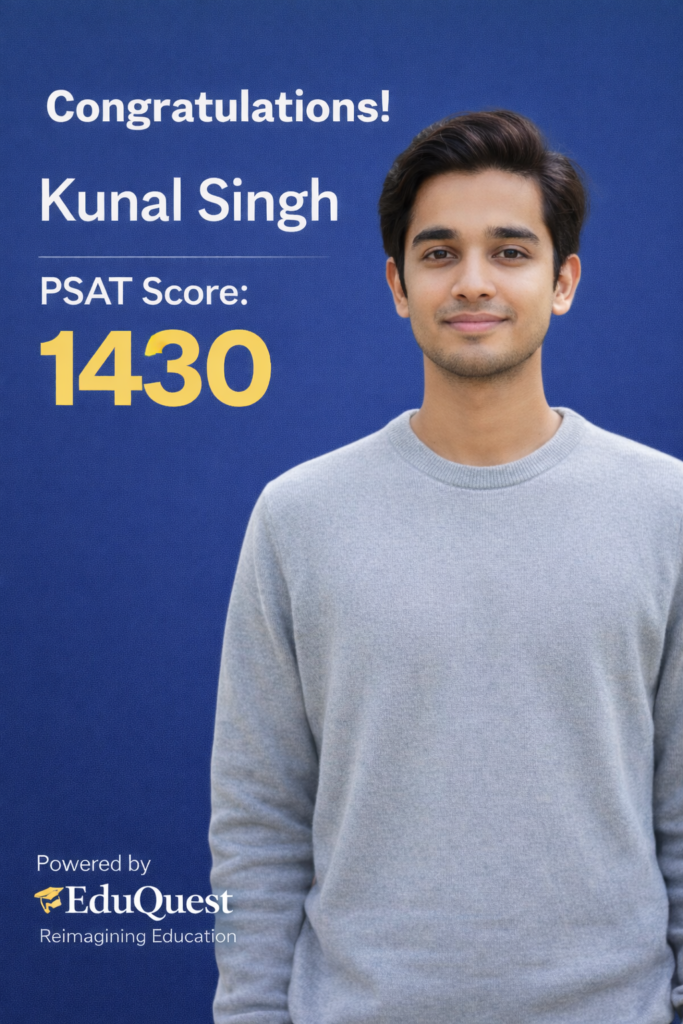
Kunal Singh
Jaipur, Rajasthan | Class IX → SAT Aspirant
Kunal Singh and the Art of Unlearning — From Board Familiarity to Global Reasoning
There exists a particular paradox in Indian education:
we produce students of formidable diligence, yet often confine them within methods that reward familiarity over thinking.
Kunal Singh’s academic journey is a study in the gentle dismantling of this paradox.
When Kunal began working with EduQuest in Class IX, he arrived well-prepared by conventional standards—orderly notebooks, complete answers, and a respectable academic record. Yet as global education entered his horizon, a quiet unease surfaced.
Kunal Singh’s PSAT journey with EduQuest reflects how structured PSAT coaching in India can transform strong board-trained students into globally ready thinkers. For students targeting US and international universities, PSAT is not just a practice exam—it is a decisive academic reorientation for SAT and beyond.
Identifying the Thinking Gap in PSAT Preparation
Kunal’s challenge was not lack of knowledge.
It was misalignment.
Board examinations had trained him to be exhaustive and methodical. Global assessments like PSAT and SAT demand something different: selectivity, decisiveness, and calibrated reasoning.
Rather than prescribing immediate instruction, EduQuest chose diagnosis.
PSAT was introduced as an intellectual provocation—a test not of memory, but of instinct—supported by a structured psychometric assessment.
EduQuest’s Diagnostic Approach to PSAT Coaching
Before PSAT preparation began, EduQuest focused on understanding how Kunal thought.
The evaluation explored:
- Analytical and numerical reasoning
- Reading behaviour under time constraints
- Decision-making with incomplete information
- Response to unfamiliar, non-routine questions
What the Assessment Revealed
- Strong analytical capability, especially in numerical reasoning
- Clear alignment with STEM, analytics, and management-oriented disciplines
- A tendency to overthink and over-explain—effective in boards, inefficient in global tests
Recognising this distinction proved pivotal.
PSAT Preparation Strategy at EduQuest: Thinking Over Memorisation
For Kunal, PSAT preparation was not about accumulation.
It was about unlearning.
The strategy focused on:
- Understanding what a PSAT question intends, not just what it states
- Learning when to abandon an unproductive line of reasoning
- Using elimination as a strategic tool
- Pairing speed with logic—without anxiety
Gradually, his thinking evolved:
from exhaustive → selective
from cautious → calibrated
from familiar → flexible
This is the core objective of PSAT coaching at EduQuest.
PSAT Score Outcome and SAT Readiness Benchmarks
PSAT Performance Overview
- Grade Taken: Class IX
- PSAT Score Achieved: 1380 / 1520
- Math: 700
- Evidence-Based Reading & Writing: 680
A PSAT score of 1380 confirmed Kunal’s readiness for structured SAT preparation and validated his transition from board-centric learning to standardised global reasoning.
Building a PSAT-Aligned Academic Profile Beyond the Exam
EduQuest believes PSAT preparation must extend beyond test scores.
To ground Kunal’s recalibrated thinking, he was guided toward Aptech professional certification, aligned with analytics and management pathways.
Through this, he developed:
- Structured problem-solving beyond textbooks
- Data interpretation in ambiguous contexts
- Practical application of logic
This phase connected reasoning with relevance.
How PSAT Thinking Translates into Research and Academic Readiness
Under mentorship, Kunal undertook a capstone project that demanded synthesis rather than recall.
He learned to:
- Frame a real-world problem
- Analyse it with restraint and structure
- Arrive at defensible conclusions
The project was later refined into a research paper, following academic conventions of citation, structure, and argumentation, and was successfully published in a journal.
This was not embellishment—it was evidence of intellectual maturity.
From PSAT to SAT: Execution Without Anxiety
By the time SAT preparation began in Class X, Kunal carried:
- PSAT-based standardised test familiarity
- A re calibrated thinking style
- Professional analytical exposure
- Research and publication experience
SAT preparation became execution, not exploration.
His performance reflected this—marked by speed, precision, and composure.
Why Kunal’s PSAT Journey Matters
Kunal Singh’s journey affirms a crucial truth:
Global readiness is not about abandoning boards.
It is about transcending them.
PSAT did not erase his prior learning.
It refined it—replacing excess with elegance and effort with efficiency.
Frequently Asked Questions About PSAT
What is PSAT and why is it important for global university admissions?
PSAT (Preliminary SAT) evaluates reading, writing, and mathematical reasoning aligned with SAT and US university expectations. It helps students transition early from board exams to global testing formats.
What is a good PSAT score?
A PSAT score above 1350 is considered strong. Kunal’s score of 1380 placed him well above average and confirmed readiness for SAT preparation.
Does PSAT require coaching?
Yes. PSAT is not syllabus-based. Structured PSAT coaching helps students develop speed, logic, and decision-making skills not tested in board examinations.
Is PSAT coaching available in India?
Yes. EduQuest offers specialised PSAT coaching in India, with online support for students preparing for SAT and global university admissions.
Begin Your PSAT & SAT Journey with EduQuest
📞 Call: +91-9958041888
🌐 Website: www.eduquest.org.in
📍 Office Address:
Office No. 1212, 1212A, Galleria,
DLF Phase-IV, Gurgaon, Haryana – 122001
EduQuest — Reimagining Education
From board preparation to global reasoning.
From familiarity to finesse.
From effort to excellence.