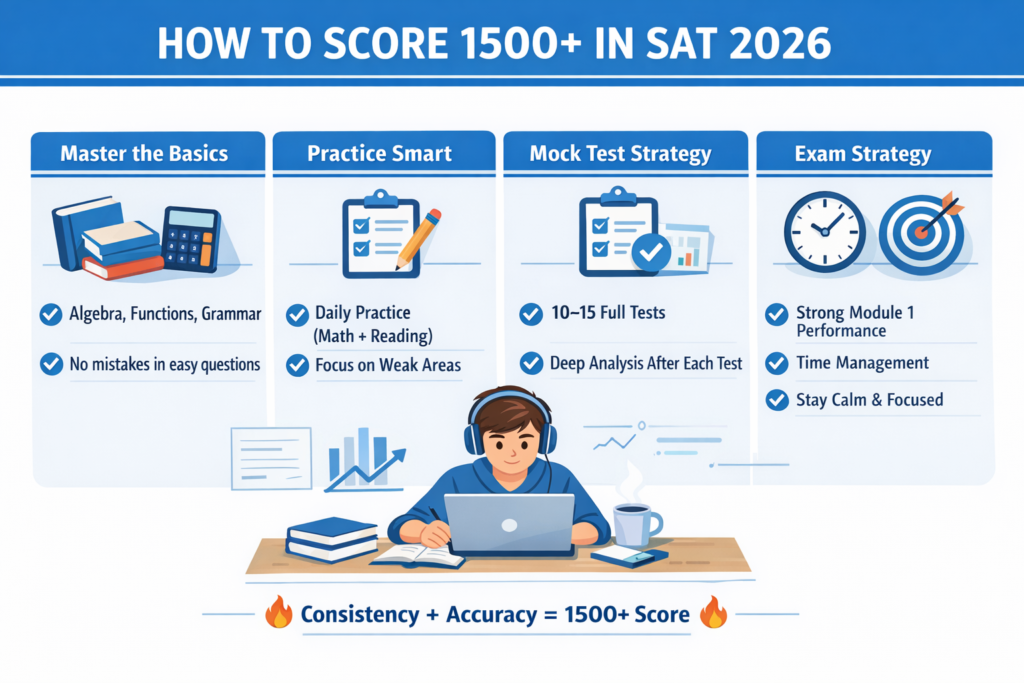

Achieving a 1500+ score on the SAT 2026 requires a focused, strategic approach. Build strong fundamentals in Math, including algebra, functions, and data analysis, and strengthen Reading and Writing skills through regular practice in comprehension, grammar, and vocabulary. Because the exam is digital and adaptive, performing well in the first module is essential to maximize your scoring potential.
Take full-length mock tests to improve speed, accuracy, and familiarity with the format, and review your mistakes to ensure continuous improvement. Prioritize time management, strategic question selection, and accuracy, and use available tools such as the built-in calculator efficiently. Consistent, targeted practice and maintaining composure under pressure are key to reaching a 1500+ score
Scoring 1500+ in the SAT 2026 requires the kind of Top 1% SAT students use a disciplined, data-driven strategy to achieve scores of 1500 or higher. They thoroughly master core concepts, especially in algebra, functions, and grammar, to ensure they do not miss easy or medium questions.
They understand the adaptive digital format and focus on excelling in the first module to access a higher scoring range in the second. Rather than practicing randomly, they identify weak areas, such as geometry or inference questions, and practice them until accuracy improves.
These students regularly take full-length mock tests under exam conditions and dedicate significant time to analyzing mistakes to prevent repeated errors.
They prioritize accuracy before building speed, ensuring precision is not compromised. In Reading and Writing, they recognize question patterns and avoid overthinking, while in Math they use efficient problem-solving strategies and make effective use of the calculator.
Above all, they maintain consistency, follow a structured study plan, and approach preparation as a long-term process rather than relying on last-minute efforts.
Students to clear the SAT exam is a combination of concept mastery, smart practice, and consistent analysis. Instead of studying randomly, they build a strong foundation in Math (algebra, functions, data analysis) and Reading & Writing (grammar, comprehension, vocabulary in context).
August 2025–June 2026 Test Dates
These test dates and deadlines apply to all students—U.S. and international—taking the SAT:
SAT Test Date* | Registration Deadline | Deadline for Changes, Regular Cancellation, |
Aug. 23, 2025 | Aug. 8, 2025 | Aug. 12, 2025 |
Sept. 13, 2025 | Aug. 29, 2025 | Sept. 2, 2025 |
Oct. 4, 2025 | Sept. 19, 2025 | Sept. 23, 2025 |
Nov. 8, 2025 | Oct. 24, 2025 | Oct. 28, 2025 |
Dec. 6, 2025 | Nov. 21, 2025 | Nov. 25, 2025 |
March 14, 2026 | Feb. 27, 2026 | March 3, 2026 |
May 2, 2026 | Apr. 17, 2026 | April 21, 2026 |
June 6, 2026 | May 22, 2026 | May 26, 2026 |
Confirmed 2026-27 Test Dates
Fall 2026
August 22, 2026
September 12, 2026
October 3, 2026
November 7, 2026
December 5, 2026
Spring 2027
March 6, 2027
May 1, 2027
June 5, 2027
.
1. Concept Mastery (Foundation First)
Build strong fundamentals in Math, Reading, and Writing
Complete syllabus coverage (Digital SAT aligned)
Topic-wise concept clarity (no rote learning)
Grammar rules, reading frameworks, math logic
Structured curriculum from basics → advanced
👉 Goal: Eliminate weak areas completely
📊 2. Smart Practice (Score Improvement Engine)
Turn concepts into consistent high performance
Sectional tests + full-length mocks
Adaptive Digital SAT practice
Error analysis & performance tracking
Time management strategies