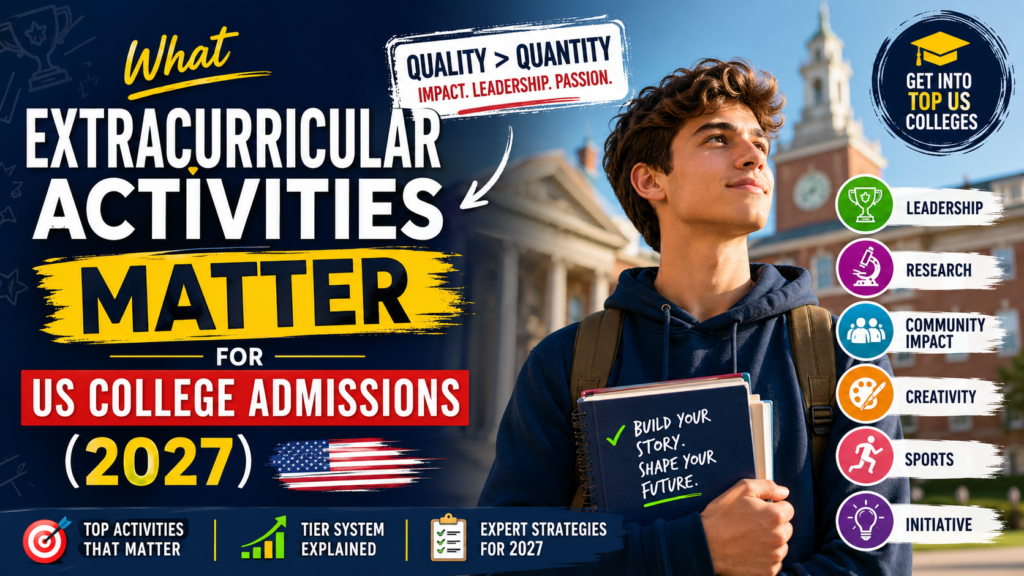
Extracurricular Activities That Actually Get You Into Top US Colleges
The complete tier-based framework used by top admissions consultants — for Indian students targeting Harvard, MIT, Stanford & the Ivies.
Why Extracurricular Activities Matter More Than Ever in 2027
Three forces have made your activity profile more critical than it has ever been for US college admissions.
Holistic Admissions Has Deepened
Harvard, Yale, and Stanford explicitly seek students who demonstrate intellectual curiosity, leadership, and meaningful impact — all expressed through extracurriculars.
The Test-Optional Wave
With more universities going test-optional post-2020, the differentiator has shifted from standardised scores to real-world impact. Your activity profile is now your most powerful asset. Maximise your SAT too →
Record Application Numbers
At 54,000+ applications for ~1,700 seats, academic excellence is merely the price of entry. What gets you in is differentiation and a singular, focused excellence.
What Colleges Look for in Extracurricular Activities
Five dimensions admissions officers evaluate when they assess your activity profile.
Extracurricular Activity Tiers: How Top Consultants Evaluate You
This tier-based framework is how top admissions consultants and former admissions officers internally evaluate extracurricular profiles for US universities.
- International Science Olympiad medals (Physics, Chemistry, Math, Biology, Informatics)
- Published peer-reviewed research or co-authored academic papers
- National-level awards: Intel ISEF finalist, Regeneron STS, Google Science Fair
- Founder of a startup with real revenue, users, or media coverage
- National team athlete, national arts competition winner, or nationally ranked musician
- Congressional internship, UN Youth Delegate, or nationally recognised public policy work
- State-level science fair, debate, or academic competition winner
- President or founder of a school club with documented community impact
- Internship at a reputable company or research lab with verifiable output
- Independently led community service project (not just volunteering hours)
- Significant role in a regional or state arts, theatre, or music ensemble
- Editor-in-chief of a school newspaper or podcast with a real audience
- Vice president or secretary of major school clubs
- Consistent volunteering with a named organization over 2+ years
- Team sports with a leadership role (captain, team manager)
- Part-time job or freelancing demonstrating responsibility and skill
- Club membership with no leadership or impact
- Short-term volunteering with no measurable outcome
- Generic hobby listings without any achievement or recognition
Spike vs Well-Rounded: What Actually Works
One of the most dangerous myths in US college admissions is that you need to be a 'well-rounded student.' This advice is now actively harmful at elite universities.
Doing 12 different activities across sports, arts, academics, volunteering, and clubs. No depth. No leadership. No impact. This profile looks like every other applicant.
Identifying one to two core areas, going extremely deep, and achieving measurable results. A student who has won a national coding competition, built a real product, and interned at a tech company has a 'spike' in computer science. That spike tells a story — and a story gets you admitted.
Use our Personality Assessment Test to identify your natural strengths and find the right spike area — before you invest years in the wrong direction.
Best Extracurriculars for US College Admissions by Career
Your application should tell a coherent story connecting your interests, activities, and intended major.
| Career Field | Best Extracurricular Activities | Target Tier |
|---|---|---|
| STEM / Engineering | Research internships, Olympiads (Math/Physics/Chemistry), Science fairs (ISEF), coding competitions (USACO, ICPC) | Tier 1–2 |
| Medicine / Pre-Med | Hospital shadowing, medical research, health NGO leadership, published case study contributions | Tier 1–2 |
| Business / Economics | Startup founding, case competition wins (Wharton Investment Competition), Stock Market Club leadership | Tier 1–2 |
| Law / Public Policy | Debate (national level), Model UN leadership, legislative internship, youth policy paper publication | Tier 1–2 |
| Arts / Humanities | Published writing, regional/national art exhibitions, award-winning film, literary journal editorship | Tier 1–3 |
| Computer Science | App/product with real users, open-source contribution, hackathon wins, AI/ML research with publication | Tier 1–2 |
| Environmental Science | Environmental policy advocacy, independently led conservation project, published research on local ecosystems | Tier 1–2 |
How Many Extracurricular Activities Do You Need?
The Common App provides 10 slots. Most successful applicants at top 20 US universities fill 8 to 10 — but quality is everything.
Your headline achievements. They define your spike.
Supporting your main narrative with depth and leadership.
Showing range without diluting your story.
Quality, consistency, and impact above all else.
Extracurricular Profiles That Got Students Into Top US Colleges
Two case-style examples showing what a high-impact extracurricular profile actually looks like.
Need help building a profile like this?
Explore Profile Building Programs →Common Extracurricular Mistakes in US College Admissions
How to Choose the Right Extracurricular Activities
Use this 4-question framework before committing to any activity. If the answer is "no" to more than two, it's unlikely to strengthen your application.
How to Build a Strong Extracurricular Profile (2027)
An actionable roadmap starting from Class 9 to build a winning profile for top US universities.
What You've Been Told vs What Actually Works
You need 10+ activities to get in
5 to 8 high-quality, high-impact activities beat 12 mediocre ones every time
Volunteering always helps
Generic volunteering without leadership or measurable impact is Tier 4 and barely moves the needle
Sports get you into Ivy League
Only if you're a recruited athlete or nationally ranked — casual team sports are Tier 3 at best
You should be well-rounded
Top universities actively prefer students with a defined spike over jack-of-all-trades profiles
Class 11 is early enough to start
Class 9 is the ideal start — Tier 1 achievements take 2 to 4 years of consistent effort to build
Any internship counts equally
Only internships with verifiable output (reports, projects, measurable results) count as Tier 2
FAQ: Extracurriculars for US College Admissions
What extracurricular activities matter most for US college admissions?
Do extracurricular activities matter more than grades for US admissions?
How many extracurricular activities do I need for a US college application?
Can hobbies count as extracurricular activities for college?
What are Tier 1 extracurricular activities?
When should I start building my extracurricular profile for US admissions?
Are Indian extracurricular achievements recognised by US colleges?
Continue Your US Admissions Journey
Your journey goes well beyond extracurricular activities. Key resources from EduQuest:
Focus on Impact, Not Just Participation
The question top US colleges are asking when they read your application is simple: what did you do that no one else did, and why does it matter?
Start early. Go deep. Lead something. Document your impact. Let every activity you choose be in service of a clear, compelling narrative.
Ready to Build a Winning Profile?
Get expert guidance from EduQuest's counsellors — specifically designed for Indian students targeting top US universities.