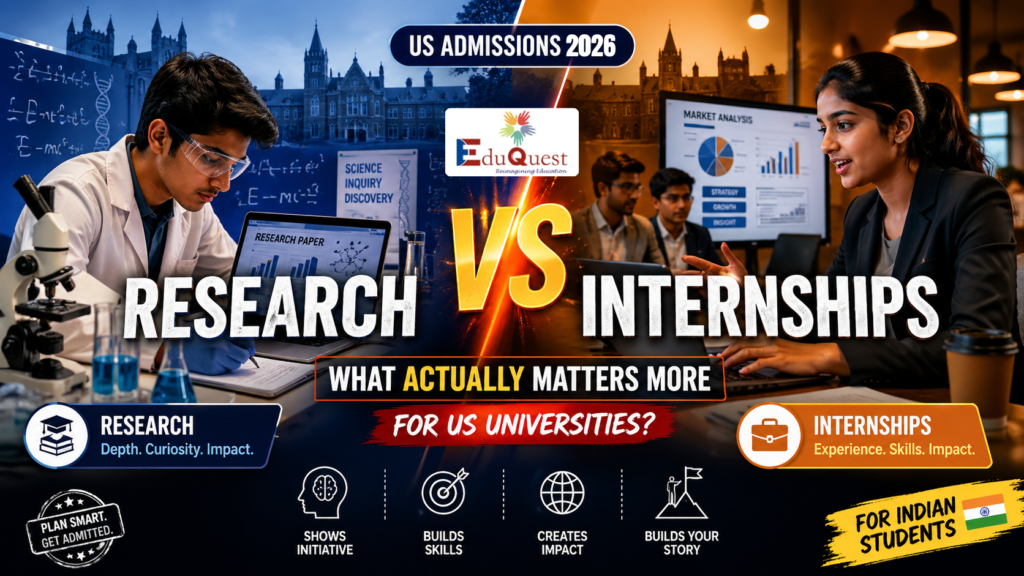
Research vs Internships: What Actually Matters More for US University Admissions in 2026?
The definitive guide for Indian students — break down when research wins, when internships lead, and how to build both into one unstoppable application narrative.
📋 Table of Contents
Research vs internships for US university admissions — this is one of the most googled questions by Class 11 students and their parents across India right now. And honestly? There is no one-size-fits-all answer. But there is a smart answer — one that depends entirely on who you are, what you want to study, and which university you are targeting.
I have sat across the table from hundreds of families asking this exact question. Parents who think a fancy internship at a corporate firm will guarantee their child a seat at an Ivy League. Students who spend an entire summer on a research paper and wonder if anyone will even notice. Both groups are partly right — and partly missing the point.
In this guide, we break down everything — what research means for US admissions, what internships signal to admissions officers, when each matters more, and how Indian students can use both strategically to build an unbeatable profile.
1. Understanding the Debate: Research vs Internships — What Do They Really Mean?
Before we compare the two, let us make sure we are talking about the same things. Both terms get used loosely — especially in the Indian study-abroad context — so clarity matters.
What Is Research in the Context of US College Admissions?
Research here does not just mean sitting in a lab. For US university admissions, research means:
- An independent or mentored academic investigation into a specific problem
- Working with a university professor, institution, or research body on a formal project
- Publishing or presenting findings — at a science fair, journal, or academic symposium
- Demonstrating intellectual curiosity and the ability to generate new knowledge
Example: A Class 11 student from Delhi who co-authored a paper on water purification methods with an IIT professor, and presented it at a national science fair — that is research that US admissions officers notice.
What Is an Internship in the Context of US College Admissions?
An internship, in the admissions context, means:
- A structured professional experience at a company, NGO, startup, or institution
- Exposure to real-world work in a relevant field
- Evidence of initiative, responsibility, and the ability to operate in a professional environment
- Ideally — a specific contribution or project you led or completed
Example: A student who interned at a fintech startup for 6 weeks, built a financial literacy module used by the company's clients, and can describe the measurable impact — that is an internship that strengthens an application.
2. What Do US Universities Actually Look for in Extracurriculars?
Here is the thing that most students and parents misunderstand: US universities — especially the Ivies and top-25 schools — do not have a checklist. They are not sitting there saying "one research paper + one internship = admit."
What they are actually evaluating is this: Does this student show genuine intellectual curiosity? Have they gone beyond the classroom? Do they have the initiative to create real impact? Does their profile tell a coherent story?
Both research and internships can answer "yes" to all of these questions — if done right. The problem is when they are done wrong.
🚩 Red Flags Admissions Officers Watch Out For
- ✗ Internships at a parent's company or family friend's firm — with no real contribution
- ✗ Research papers "co-authored" with no real involvement from the student
- ✗ Activities that exist only on paper and have no external validation
- ✗ A profile that is clearly manufactured rather than organically grown
Not sure which path fits your natural strengths? Take EduQuest's Personality Assessment Test to discover where your authentic interests lie — before you pick research or internship.
3. Research vs Internships: The Head-to-Head Comparison
Let us put them side by side across the dimensions that matter most in US university applications:
| Factor | Research | Internship |
|---|---|---|
| Academic signal | Very high — shows intellectual depth | Moderate — shows professional awareness |
| Best suited for | STEM, social sciences, humanities majors | Business, policy, design, media, law |
| External validation | Publications, awards, symposia | Company name, project outcomes, references |
| Admissions essay material | Rich — unique intellectual journey | Good — professional growth story |
| Difficulty to fake | Hard to fake with substance | Easier to fake — must show real impact |
| Ideal start time | Class 10–11 | Class 11–12 (or gap / summer) |
| Ivy League preference | Often preferred for research universities | Valued for professional school programs |
| Indian student advantage | High — professors, Olympiads, IITs nearby | Moderate — requires strong networking |
Key Insight: Research tends to carry more weight for academically competitive schools like MIT, Harvard, and Princeton. Internships carry more weight for schools with strong professional programs like UPenn Wharton, Cornell Dyson, or Georgetown.
4. When Research Matters More: Who Should Prioritise It?
Research is your stronger card if one or more of the following is true:
STEM-Heavy Major
CS, Biology, Chemistry, Physics, Neuroscience — research is a near-mandatory differentiator at MIT, Stanford, CMU, Caltech.
Research-Focused Universities
MIT, Caltech, Johns Hopkins, UChicago — demonstrating independent research tells them you'll thrive in their environment.
Strong Research Mentor
IITs, NITs, AIIMS, TIFR — many Indian professors will mentor exceptional high school students. This is a massive advantage most don't pursue.
You Are Applying for a STEM-Heavy Major
Computer Science, Biology, Chemistry, Physics, Mathematics, Neuroscience — for all of these, research experience is a near-mandatory differentiator. The top CS programs in the US receive thousands of applications from students with perfect scores. Research is what separates the pile.
You Want to Apply for Research-Focused Universities
Schools like MIT, Caltech, Johns Hopkins, and UChicago have a heavy research culture. Demonstrating that you have already done independent research — even a small project — tells them you will thrive in their environment.
You Have Access to a Strong Research Mentor
Indian students actually have a unique advantage here. IITs, NITs, AIIMS, and many regional universities have professors willing to mentor high school students. If you can get even an informal mentorship, it opens the door to co-authoring papers, presenting at fairs, and building a deeply credible research portfolio.
Our AI Career Advisor can help map potential research domains that align with your interests and target university requirements. Try it free.
5. When Internships Matter More: Who Should Prioritise Them?
Internships become your stronger card when:
Business, Law, Policy, Media
For Economics, Political Science, Journalism, Film, or Business — professional exposure speaks louder than a research paper.
Strong Practical Spike
If your profile centres on entrepreneurship, social impact, or creative industries — real-world experience makes your narrative credible.
Real, Measurable Project
Passive observation doesn't count. You need to have built something, solved a problem, or led a project with measurable outcomes.
You Are Applying to Business, Law, Policy, or Media Programs
For majors like Economics, Political Science, Journalism, Film, or Business — professional exposure speaks louder than a research paper. An internship at a newspaper, policy think-tank, NGO, or startup gives you real-world stories to tell — and admissions officers love that authenticity.
You Have Built a Strong Spike Around a Practical Domain
If your entire profile is about entrepreneurship, social impact, or creative industries — an internship that demonstrates you have operated in the real world makes your spike far more credible. A student who says they are passionate about sustainable fashion and has actually interned at a sustainable brand is infinitely more convincing than one who just joined the school's eco-club.
Your Internship Involved a Real, Measurable Project
The biggest mistake students make with internships: being a passive observer. If you shadowed someone for 4 weeks and did nothing independently — that's work experience, not an internship that moves the needle. What counts is: Did you build something? Solve a problem? Lead a project? Present to stakeholders?
Strong Internship Signal: "I interned at a healthtech startup where I designed a patient onboarding flow that reduced drop-off by 30%." That is impact. That is a story.
6. The Real Answer: Research AND Internships — But Done Strategically
Here is the honest truth that most guides don't tell you: the best US university applicants don't choose between research and internships. They do both — but in a way that serves one larger narrative.
Think of it as layers of the same spike. Your anchor interest stays constant. Research deepens the intellectual side of that interest. An internship proves you can apply it in the real world. Together, they make your application almost impossible to ignore.
The 'Depth + Application' Framework for Indian Students
Here is a framework we use at EduQuest for students targeting top US universities:
Identify your anchor interest — Science? Entrepreneurship? Public Health? This becomes the north star of your entire profile.
Build intellectual depth through research — mentored project, paper, competition that demonstrates academic rigour.
Build applied credibility through internship — real-world impact in the same domain, showing you can execute, not just theorise.
Connect both through your Common App essay — one coherent narrative that shows intellectual growth and practical initiative.
Let your recommendations validate both sides — from your research mentor and internship supervisor, ideally.
Example: A student interested in public health does research on antibiotic resistance patterns in Indian cities (academic depth), AND interns with a public health NGO documenting field data (applied experience). Both point to the same passion. That is a spike that writes itself into an essay.
7. Research vs Internships for Indian Students: What You Need to Know
If you are an Indian student reading this, there are some specific realities worth understanding.
Why Indian Students Often Underestimate Research
Many Indian families associate research with PhDs and professors — not with 16-year-olds. But the global applicant pool has shifted dramatically. Students from the US, South Korea, China, and Singapore routinely present research papers as part of their applications. Indian students who discount research are giving up a massive competitive advantage.
India has world-class academic institutions — IITs, IISc, AIIMS, TIFR — many of which are open to mentoring exceptional high school students. This is an opportunity most Indian students simply do not pursue.
Indian Advantage: Your proximity to IITs, NITs, AIIMS, and IISc is a genuine competitive asset. A mentorship from an IIT professor on a research project is highly credible to US admissions committees. Use it.
Why Indian Internships Often Don't Land
On the flip side, many Indian students do internships — but they pick them based on brand name or parental connections rather than genuine alignment with their academic goals. An internship at a relative's CA firm does nothing for your software engineering application. A self-initiated internship at a small AI startup where you built a real feature does everything.
The lesson: relevance + impact > brand name. At EduQuest, we help students identify and pursue internship opportunities that genuinely align with their intended major and spike profile — not just whatever is easiest to access.
8. How EduQuest Helps You Choose — and Execute — the Right Strategy
At EduQuest, we do not give generic advice. We sit with each student individually, understand their academic strengths, target universities, and intended major — and then build a personalised roadmap that answers exactly this question: should you focus on research, internship, or both?
Spike Discovery Sessions
Identify your core interest, natural strengths, and the narrative that ties everything together.
Research Mentorship Connections
We help students find real professors and research programmes — India and international.
Internship Strategy
Identifying opportunities aligned with your spike and major — not just what's easiest to access.
SAT + AP Coaching
So your academics don't lag behind your extracurriculars. Strong scores amplify everything.
Essay Coaching
Turning your research and internship into compelling application stories — Common App to supplementals.
End-to-End Common App Support
From activity list to supplemental essays — full-cycle guidance for every step.
Whether you are in Class 9 building your foundation or in Class 12 rushing to finalise your application — EduQuest's profile building program is built for exactly this journey.
Still figuring out your direction? Talk to our expert on WhatsApp for a free consultation — no pressure, just clarity.
9. FAQs: Research vs Internships for US University Admissions
10. Final Verdict: Research vs Internships — Which Should You Choose?
🔬 Prioritise Research if…
You are applying to STEM or research-intensive programmes → prioritise research, and layer an aligned internship on top. MIT, Stanford, Caltech, Hopkins.
💼 Lead with Internship if…
You are applying to business, policy, social impact, or creative programmes → lead with internship, and back it up with intellectual depth through projects or independent study.
🌟 Do Both (Ideal) if…
You can do both, aligned to one core spike → do both. That is the ideal scenario. One unified narrative. Two layers of evidence. Impossible to ignore.
But above all — do not do either of these things passively. Every activity on your application needs to have a story, an impact, and a connection to who you are as a student and who you want to become.
The difference between a student who gets into MIT and one who doesn't is rarely GPA or test scores at the top end. It is the clarity of purpose, the depth of engagement, and the authenticity of the narrative.
EduQuest has helped hundreds of Indian students build world-class profiles for Ivy League and top US universities. We don't just advise — we build the roadmap, find the opportunities, and guide you every step of the way.
Still figuring things out? Take our Personality Assessment Test to discover your natural academic strengths, or use our AI Career Advisor to map a personalised roadmap for your US university journey.
📞 Speak Directly to an Expert: WhatsApp +91-9958041888 │ 📧 contact@eduquest.org.in │ 🌐 eduquest.org.in
EduQuest SEO Strategy Team
This guide was prepared by the EduQuest admissions strategy and content team. EduQuest is India's leading US university admissions consultancy, helping students from Class 9–12 build world-class profiles for Ivy League and top US universities. Learn more at eduquest.org.in.
Ready to Build a Profile That Gets Noticed?
EduQuest has helped hundreds of Indian students win admissions to MIT, Harvard, Cornell, and top-25 US universities. Let's build your roadmap today.
📄 Get Your Free PDF Guide
Enter your details below and we'll send you the complete Research vs Internships strategy guide instantly.
You're All Set!
Thank you! Your free PDF guide has been sent to your email. While you wait, download it directly below.
📥 Download PDF Guide