The Ultimate 12-Month Study Abroad Roadmap for Indian Students (2027 Intake)
Every year, over 13 lakh Indian students apply to universities abroad — and thousands of them miss scholarships, top-ranked programmes, and even visa slots because they started too late. The 12-month study abroad roadmap is not just a timeline — it is the difference between a rejection email and an acceptance letter from your dream university.
If you are targeting the Fall 2027 intake, your preparation window is open right now. This guide — built from real experience with Indian students admitted to Yale, Stanford, UCL, NUS, and the University of Toronto — walks you through every single month of the study abroad process: from country research and test prep to SOPs, visa, and pre-departure planning.
Whether you are a Class 11/12 student planning undergraduate admissions abroad, or a graduate targeting an MS or MBA, this complete 12-month study abroad roadmap for Indian students is your execution guide for 2027. Applicable for the US, UK, Canada, Australia, Singapore, and Europe.
📌Why Indian Students Need a 12-Month Study Abroad Plan
The global admissions landscape in 2027 is more competitive than ever. Top US universities now receive over 60,000+ applications per cycle. UK universities under UCAS have strict October deadlines. Canadian universities have capped international intakes. If you do not have a structured study abroad timeline for Indian students, you will find yourself chasing deadlines instead of opportunities.
Here is why 12 months is the minimum preparation time:
- IELTS/GRE/SAT preparation: 4–6 months of dedicated study + retake buffer
- SOP writing: A compelling Statement of Purpose takes 6–8 weeks of drafting, feedback, and revision
- LOR management: Professors and managers need at least 6–8 weeks of notice
- Scholarship deadlines: Most major scholarships close 6–9 months before your intake
- Visa processing: Student visas for the US (F-1), UK, Canada, and Australia require 2–3 months minimum
- Profile building: Internships, research papers, and extracurriculars cannot be created overnight
Students who have gone through EduQuest's Study Abroad Counselling programme consistently say: "I wish I had started earlier." Do not be one of them.
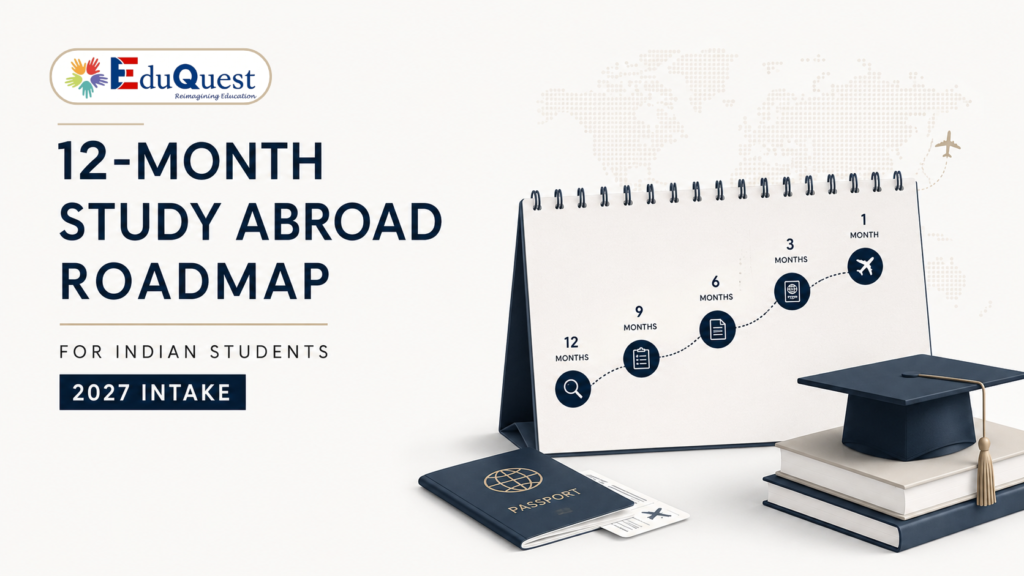
📅Quick Overview: The 12-Month Study Abroad Roadmap at a Glance
Use this table as your master reference. Bookmark it, print it, pin it. This is your study abroad application timeline for the 2027 intake:
| Timeline | Main Goal / Action |
|---|---|
| 12Months Before | Research countries, universities & career goals |
| 11Months Before | Profile building – internships, projects, volunteering |
| 10Months Before | Start IELTS / GRE / SAT preparation |
| 9Months Before | Shortlist universities (dream, target, safe) |
| 8Months Before | Draft SOPs, essays & arrange LORs |
| 7Months Before | Submit applications (Early Decision/Rolling) |
| 6Months Before | Apply for scholarships & financial aid |
| 5Months Before | Interview preparation |
| 4Months Before | Receive & compare offer letters |
| 3Months Before | Student visa application & documentation |
| 2Months Before | Accommodation booking & forex/insurance |
| 1Month Before | Travel prep, SIM cards, packing & pre-departure |
Now let's dive deep into each month — with specific tasks, tools, mistakes to avoid, and India-specific guidance you will not find anywhere else.
🔍12 Months Before Your 2027 Intake: Research & Career Clarity
What to Do This Month
This is the most underutilised month in the study abroad preparation roadmap. Most students waste it. Winners use it to build a strategic foundation.
Choose your destination country: US, UK, Canada, Australia, Singapore, Germany, or Netherlands — each has a different admissions culture, cost structure, and post-study work opportunity.
Define your career goal: Work backwards from the job you want at 27 to the degree and university you need at 22.
Set a realistic budget: Include tuition, living costs, travel, health insurance, and contingency. Factor in scholarship potential.
Research 30–40 universities: Use tools like QS World Rankings, Times Higher Education, and the official university websites.
Understand UG vs PG requirements: UG applications (Common App, UCAS) and PG applications have entirely different processes, documents, and timelines.
🏆11 Months Before: Aggressively Build Your Profile
What to Do This Month
For Class 11 students: This is your most important period for profile building for study abroad. Universities abroad do not just look at your grades — they look at who you are outside the classroom.
- Apply for relevant internships in your field of interest (research labs, NGOs, startups)
- Volunteer for community service or social impact projects
- Begin or deepen involvement in extracurricular activities — debate, robotics, coding, journalism
- Start a project, blog, or research initiative that connects to your intended major
- Optimise your LinkedIn profile with all academic achievements and activities
- Consider presenting at school competitions, TEDx, or youth summits
For Class 12 or postgraduate applicants, focus on strengthening existing profile elements rather than starting from scratch. Quality over quantity matters.
EduQuest offers dedicated Profile Building for Class 11 students and Profile Building for Class 12 students — customised mentorship designed to make Indian students competitive for global universities.
📝10 Months Before: Start Your IELTS, GRE or SAT Preparation
What to Do This Month
This is the single biggest bottleneck for Indian students in the study abroad process step by step. Delaying test prep is the number one reason students miss deadlines.
- IELTS / TOEFL: Begin preparation in Month 10, take the first attempt in Month 7, keep Month 5 as a retake buffer
- GRE / GMAT (PG): 3–4 months of focused preparation, aim for first attempt in Month 8
- SAT / ACT (UG): 5–6 months minimum; start in Month 10 for a Month 5 first attempt
At EduQuest, we have guided thousands of students to competitive scores. Our IELTS Coaching, SAT Coaching, and GRE preparation programmes are designed around the Indian student's study schedule.
🎯9 Months Before: Shortlist Universities Strategically
The Dream-Target-Safe Framework
University shortlisting is not about ranking alone. A smart study abroad application timeline requires you to apply to 8–12 universities across three tiers:
- Dream Universities (2–3): Reach schools. Low acceptance rate, but worth trying. (Eg. MIT, UCL, NUS)
- Target Universities (5–6): Realistic based on your profile. Strong ROI and placement records.
- Safe Universities (2–3): High acceptance probability. Still quality institutions with strong outcomes.
Key Factors to Evaluate for Each University
- Acceptance rate for international Indian students
- Course curriculum and specialisation fit
- Post-study work visa policies (crucial for US OPT, UK Graduate Route, Canada PGWP)
- Scholarship availability for Indian students
- Average package of graduates in your intended field
- Location and cost of living
✍️8 Months Before: SOP, Essays & Letter of Recommendation Strategy
The Most Critical Documents in Your Application
Your Statement of Purpose (SOP) and application essays are what separate you from 10,000 other Indian students with similar grades. This section of the 12-month study abroad roadmap demands your most serious attention.
SOP Writing Strategy
- Start with a compelling personal story — not a biodata recitation
- Connect your past experiences to your future goals
- Research each university's specific programme and reference it in your SOP
- Get at least 3–4 rounds of feedback before finalising
- Avoid clichés: 'Since childhood I have been fascinated...' is a red flag for admissions officers
LOR (Letter of Recommendation) Strategy
- Request LORs from professors/managers who know your work deeply — not just your grade
- Give recommenders a 'brag sheet' — a document highlighting your key projects and achievements
- Request at least 6–8 weeks before your first application deadline
- Have a backup recommender ready
EduQuest's expert admission counselling team works 1-on-1 with students on SOP drafting, personalisation, and university-specific essay strategy.
📬7–6 Months Before: Applications & Scholarship Research
Submitting Applications
For the Fall 2027 intake, most US universities have Early Decision/Early Action deadlines in November 2026 and Regular Decision deadlines in January 2027. UK UCAS deadlines for Oxford/Cambridge are mid-October 2026. Start submissions in Month 7 for ED/EA rounds.
- Complete the Common App / Coalition App / UCAS by Month 7 for early rounds
- Submit at least 3–4 applications in Month 6 as rolling admissions open
- Track every application deadline on a shared spreadsheet
Scholarship Applications — Don't Miss This
This is what most competitors' blogs miss entirely. Indian students leave millions of rupees in scholarship money unclaimed every year.
- Chevening Scholarships (UK): Applications typically open August–November
- Fulbright (US): Deadline is usually July–August
- Australia Awards: Apply 6–9 months before intake
- QS Scholarships, Inlaks, JN Tata — all require early planning
- University-specific merit scholarships: Apply at the time of admission application
Need help with SOPs, university shortlisting, or scholarship strategy?
Our counsellors have helped students win over $8 million in scholarships. Let us build your personalised plan.
👉 Talk to an EduQuest Expert Right NowExplore Study Abroad Services
🎤5–4 Months Before: Interview Preparation & Offer Letters
University Interview Preparation
Some universities — especially for MBA, medicine, and competitive UG programmes — require personal interviews. Prepare for these seriously:
- Research the programme faculty and recent news about the department
- Practice mock interviews with real feedback (EduQuest offers recorded mock sessions)
- Prepare your 'Why this university?' answer with specifics — not generic praise
- Have structured answers for: strengths, weaknesses, career goals, and gap years (if any)
Comparing Offer Letters
When offers arrive, compare universities on:
- Total scholarship and financial aid awarded
- Course structure, electives, and research opportunities
- Graduate employment rate in your target industry
- Location's job market for your domain (e.g., New York for finance, Silicon Valley for tech)
- Cost of living vs scholarship — the real net cost
🛂3 Months Before: The Student Visa Process for Indian Students
Visa Documentation Checklist
The student visa process is where many Indian families panic. But with the right preparation, it is entirely manageable. Here is what you need for the most common destinations:
- I-20 form from your US university
- SEVIS fee payment receipt (Form I-901)
- DS-160 online application
- Financial documents: Bank statements showing funds for at least 1 year of study
- Academic transcripts, test scores, and admission letter
- Visa interview appointment at the US Embassy/Consulate
- CAS number from your UK university
- English language test results (IELTS minimum band 5.5–6.5 depending on course)
- Financial documents showing 28 consecutive days of funds
- ATAS certificate (for certain STEM courses)
✈️2–1 Months Before: Accommodation, Forex & Pre-Departure
2 Months Before
- Book on-campus housing (most universities have priority deadlines) or research off-campus options
- Get a forex card — Wise, Niyo Global, or IndusInd Forex are popular with Indian students
- Purchase international health insurance (often mandatory)
- Notify your Indian bank about overseas use of your debit/credit cards
1 Month Before
- Get an international SIM plan or research local SIM options in your destination country
- Collect all original documents: marksheets, birth certificate, passport, offer letter, visa
- Download offline maps and key apps for your city
- Connect with your university's Indian student association
- Attend any pre-departure orientation hosted by EduQuest or your institution
- Confirm your airport pickup, bank account opening plan, and first week accommodation
⚠️Top 8 Mistakes Indian Students Make in Study Abroad Planning
After counselling thousands of students, EduQuest's admissions team has identified the most damaging — and most avoidable — mistakes in the study abroad preparation roadmap for Indian students:
| ❌ Mistake | Why It Hurts You |
|---|---|
| Starting IELTS/GRE Too Late | Many students give IELTS just 2–3 months before deadlines. You need 5–6 months minimum for prep, attempts & retakes. |
| Writing Generic SOPs | A copy-paste SOP that reads like every other Indian applicant kills your chances. Universities reject templates instantly. |
| Applying Only by Rankings | Rank 1 vs Rank 50 means little if the ROI, course quality, or job placement records differ. Research deeply before applying. |
| Ignoring Scholarships | Most Indian students skip scholarship research. Billions in aid goes unclaimed annually because students apply too late or not at all. |
| Weak Extracurriculars | Just grades are not enough. Top universities want leaders, researchers, and creators — not just toppers. |
| No Profile Building in Class 11 | Students who wait till Class 12 to build their profile lose 12+ months of competitive advantage. |
| Applying to Too Few Universities | Applying to only 3–4 universities is a serious gamble. A balanced list of 8–12 is the standard. |
| Poor Visa Documentation | A single missing document can delay or reject your student visa. Start the process 3 months in advance, not one. |
❓Frequently Asked Questions (FAQs)
Ideally 12 months before your intake date. For Fall 2027, begin in June–July 2026. The earlier you start, the more time you have for profile building, test prep retakes, and scholarship applications.
Yes — if you follow this 12-month study abroad roadmap consistently. Many students have secured admissions to top 50 global universities within this timeline. However, earlier is always better for profile building.
Aim for your first IELTS attempt in Month 7 (approximately November–December 2026). This gives you time for a retake in Month 5 if needed, well before most application deadlines.
We recommend applying to 8–12 universities: 2–3 dream schools, 5–6 target schools, and 2–3 safe schools. Do not put all your eggs in 3–4 baskets.
For Early Decision/Action rounds (US): October–November. For Regular Decision (US): December–January. For UCAS (UK): By October for Oxford/Cambridge, by January for most others.
Yes. Programmes like Chevening, Fulbright, Australia Awards, and numerous university-specific merit scholarships offer full or partial funding. Early research (Month 6–7 of this roadmap) is essential.
🚀Conclusion: Your 12-Month Study Abroad Roadmap Starts Today
The difference between a student who gets into their dream university and one who settles for second-best is almost never intelligence. It is timing, strategy, and execution. This 12-month study abroad roadmap for Indian students gives you all three.
Start your 12-month study abroad roadmap in Month 12 with country research and career clarity. Build your profile in Month 11. Begin IELTS or GRE prep in Month 10. Shortlist universities in Month 9. Draft your SOPs in Month 8. Apply and chase scholarships in Months 7–6. Prepare for interviews in Months 5–4. Navigate your visa in Month 3. And land abroad fully prepared in Months 2–1.
At EduQuest, we have spent over 20 years helping Indian students win admissions to Ivy League and Russell Group universities with millions of dollars in scholarships. Our team of expert counsellors, SOP writers, test prep coaches, and visa specialists work together to make your study abroad dream a reality — on time, on strategy, and on budget.
Explore our Study Abroad Services, IELTS Coaching, SAT Coaching, and Profile Building Programmes — or simply reach out to talk to one of our counsellors today.
Ready to Start Your 12-Month Study Abroad Roadmap for 2027?
Get a personalised, step-by-step action plan built by EduQuest's senior admissions counsellors — absolutely FREE. Over 20,000 students have trusted us. Now it's your turn.
👉 Start My FREE Study Abroad Planning Session on WhatsApp📚 Explore More from EduQuest
Related guides and resources to help you at every stage of your study abroad journey: