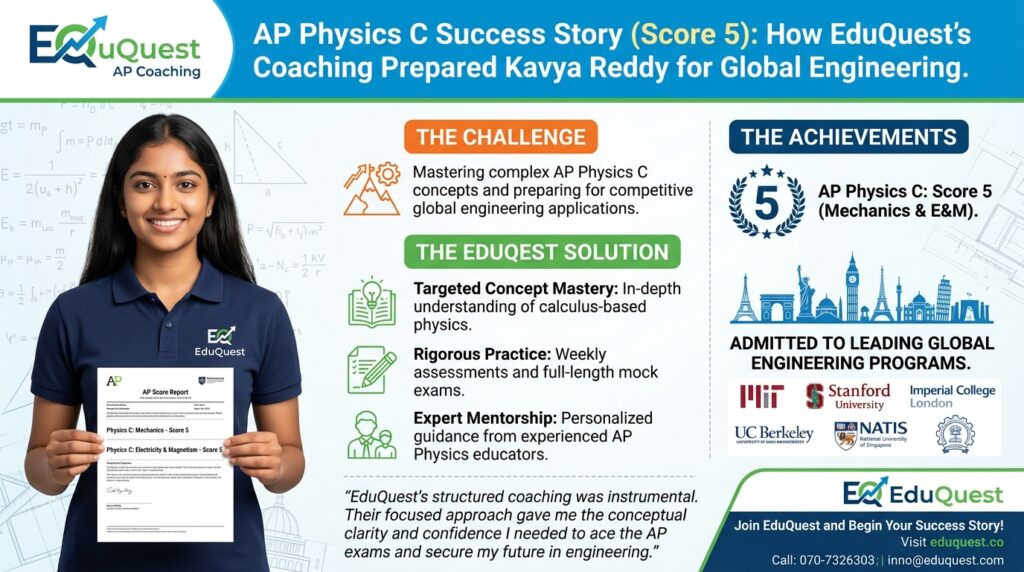
Kavya Reddy
Hyderabad, Telangana | Female
Engineering Readiness Through Applied Physics, Mathematics, and Computational Logic
For students targeting top global engineering universities, school grades alone are no longer sufficient. Universities seek clear evidence of calculus-based applied reasoning, interdisciplinary problem-solving, and readiness for first-year engineering rigor.
Kavya Reddy’s AP journey with EduQuest reflects how structured AP coaching in India can transform school-level science into university-ready engineering thinking. For students applying to competitive engineering programs in the US, UK, and beyond, AP Physics C—supported by Calculus and Computer Science—is not just an exam pathway, but a decisive academic differentiator.
Identifying the Engineering Readiness Gap in AP Preparation
Kavya showed a consistent academic inclination toward mechanical and electrical engineering. Her school performance in Physics and Mathematics was strong and reliable.
However, global engineering admissions exposed a gap:
- School Physics relied heavily on formulas
- Engineering programs demanded calculus-driven application
- Universities expected proof across physics, mathematics, and computation
- Competition among engineering applicants was extremely high
Kavya needed an academic signal that demonstrated engineering thinking across domains, not isolated subject strength.
EduQuest’s Diagnostic Approach to AP Coaching
Before finalising AP subjects, EduQuest adopted a diagnostic-first approach, focusing on how Kavya thought—not just what she knew.
The assessment examined:
- Integration of calculus with physical systems
- Multi-step numerical reasoning under constraints
- Logical structuring and abstraction
- Comfort with algorithmic and computational thinking
Diagnostic Conclusion
A three-subject AP engineering strategy would best represent Kavya’s readiness for global engineering programs:
- AP Physics C (Mechanics) – applied engineering physics
- AP Calculus – mathematical foundation
- AP Computer Science – computational logic and problem decomposition
AP Preparation Strategy at EduQuest: Engineering Thinking Across Disciplines
EduQuest designed a preparation plan emphasising application, integration, and precision across complementary AP subjects.
AP Physics C (Mechanics)
- Calculus-based kinematics and dynamics
- Work, energy, and rotational motion
- Translating physical systems into equations
- Multi-step applied problem solving
AP Calculus
- Derivatives and integrals as engineering tools
- Mathematical modelling and optimisation
- Logical structure and precision
AP Computer Science
- Algorithmic thinking
- Problem decomposition
- Logical efficiency and structured reasoning
Preparation emphasised:
- AP-style MCQs and Free Response Questions
- Accuracy before speed
- Cross-subject reasoning transfer
- Structured thinking under time constraints
Kavya was trained to approach problems as an engineer, not a rote learner.
AP Score Outcome and University Expectations
AP Performance Overview
| AP Subject | Typical Competitive Requirement | Ideal Benchmark | Kavya’s Score |
| AP Physics C (Mechanics) | 4 | 5 | 5 |
| AP Calculus | 4 | 5 | 4 |
| AP Computer Science | 3–4 | 4–5 | 4 |
What These Scores Demonstrated
- Strong integration of calculus and physics
- Applied engineering problem-solving ability
- Computational logic aligned with modern engineering curricula
These results became key academic highlights in Kavya’s global university applications.
Building an AP-Aligned Engineering Profile Beyond the Exam
AP subjects were not treated as standalone credentials.
Through EduQuest’s academic planning, Kavya’s AP preparation aligned with:
- Engineering major selection
- First-year university physics and mathematics expectations
- Long-term academic sustainability in demanding STEM environments
This ensured her profile reflected depth, application, and intellectual maturity.
How AP Preparation Translates into Engineering Admissions Success
With a strong three-subject AP engineering profile, Kavya received positive admissions outcomes, including:
- Offers from top global universities for engineering programs
- Strong consideration for mechanical and electrical engineering majors
- Recognition of AP Physics C for first-year engineering readiness
- AP Computer Science supporting technology-driven coursework
Her AP credentials positioned her as a student ready for engineering from the first semester.
Why Kavya’s AP Success Matters
Kavya’s journey reinforces a central admissions truth:
Engineering readiness is multidimensional.
A Physics C + Calculus + Computer Science AP strategy:
- Signals applied STEM maturity
- Demonstrates interdisciplinary engineering thinking
- Differentiates applicants in competitive pools
- Aligns strongly with elite global engineering programs
AP Physics C, when supported by mathematics and computation, becomes objective proof of engineering preparedness.
Frequently Asked Questions About AP Physics C & Engineering APs
What is AP Physics C and why is it important for engineering admissions?
AP Physics C evaluates calculus-based mechanics, closely aligned with first-year engineering physics at global universities.
What AP score is considered competitive for top engineering programs?
Most competitive universities expect 4 or 5. Kavya’s score of 5 exceeded ideal benchmarks.
Does AP Physics C require coaching?
Yes. AP Physics C requires integration of calculus, physics, and time-bound reasoning—structured coaching is strongly recommended.
Is AP coaching available in India?
Yes. EduQuest offers specialised AP coaching in India, with offline centres and online support for global engineering applicants.
Begin Your AP Engineering Journey with EduQuest
📞 Call: +91-9958041888
🌐 Website: www.eduquest.org.in
📍 Office Address:
Office No. 1212, 1212A, Galleria,
DLF Phase-IV, Gurgaon, Haryana – 122001
EduQuest — Reimagining Education
Preparing students not just to enter engineering programs — but to excel in them.