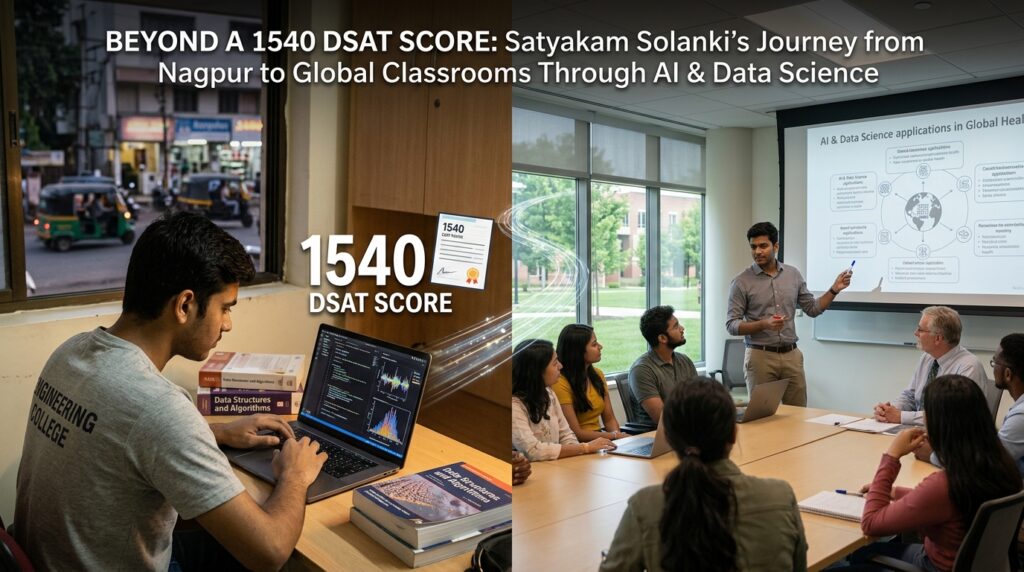
In today’s global admissions ecosystem, universities no longer evaluate students only by marks or test scores. They look for analytical thinkers, problem solvers, and students who can apply learning to real-world challenges.
This is the story of Satyakam Solanki, a focused and ambitious student from Nagpur, Maharashtra, who built a future-ready global undergraduate profile by combining Digital SAT (DSAT) excellence with a high-rigor AI & Data Science profile spike, under the strategic mentorship of EduQuest.
A Student Who Wanted His Profile to Mean More
Satyakam had a natural inclination toward technology, analytics, and data-driven thinking. While his academic foundation was strong, he clearly understood one critical truth about global admissions:
Strong academics alone are no longer enough to stand out.
Like many high-potential students, he faced familiar challenges:
- Competing with thousands of academically capable applicants worldwide
- Understanding how DSAT preparation fits into a long-term admissions strategy
- Converting interest in AI and data into measurable, university-level outcomes
- Building a profile that reflected innovation and impact, not just exam scores
What he needed was not fragmented preparation—but a clear, structured roadmap.
That’s when he partnered with EduQuest.
The EduQuest Philosophy: Build Depth, Not Just Scores
EduQuest approached Satyakam’s journey with a clear belief:
Top universities reward rigor, relevance, and demonstrated ability.
Instead of focusing only on test performance, EduQuest applied its Perfect Spike Creation Methodology—a multi-layered framework aligned with how global universities evaluate undergraduate applicants.
This ensured that Satyakam’s profile would show direction, depth, and differentiation.
Step 1: Digital SAT Preparation with Strategy
Satyakam’s DSAT journey began with a structured process:
- Diagnostic testing to assess baseline readiness
- A customised DSAT preparation roadmap
- Adaptive testing strategies aligned with the digital exam format
- Regular mock tests with deep performance analytics and mentoring
This process helped him build speed, confidence, and consistency, ensuring that DSAT preparation strengthened—not overshadowed—his overall profile.
Digital SAT Result (Clearly Explained)
- Maximum Possible DSAT Score: 1600 / 1600
- Ideal Competitive Range for Top Global Universities: 1530 – 1590
- Satyakam’s Final DSAT Score: 1540 / 1600
A 1540 score places Satyakam firmly within the ideal global admissions range, reflecting strong mastery across reading, writing, and mathematics. This score provided a solid academic foundation, while EduQuest ensured his profile extended far beyond numbers.
Step 2: The Profile Spike — AI & Data Science Professional Certification
To establish technical depth, Satyakam enrolled in a Professional AI & Data Science Certification, guided by EduQuest.
This was not a surface-level or short-term course.
It demanded:
- Structured curriculum delivery
- Applied learning with assessments
- Conceptual clarity in analytics and machine learning
- Hands-on execution with real datasets
Through this program, he developed expertise in:
- Python for Data Analysis
- Machine Learning fundamentals
- Data visualisation and insight generation
- Model building and evaluation
This stage gave his profile technical credibility and academic seriousness—qualities global universities value highly.
Step 3: Capstone Project — Applying AI to a Real Urban Challenge
Under expert mentorship, Satyakam translated his learning into a real-world solution through a capstone project.
Capstone Project Title
“AI-Based Smart Traffic Flow & Congestion Prediction System”
Using machine learning models, the project:
- Analysed historical and real-time traffic data
- Predicted congestion patterns and peak stress points
- Proposed AI-driven solutions for urban traffic optimisation
- Addressed a critical challenge faced by rapidly growing cities
What made this project stand out was its clear social relevance and practical application.
It demonstrated Satyakam’s ability to use AI not just as a technical skill, but as a tool for real problem solving.
Step 4: Research Orientation & Academic Documentation
To further strengthen his application, EduQuest guided Satyakam in presenting his capstone work in a research-oriented academic format.
He:
- Structured the project with defined methodology and results
- Focused on analytical reasoning and outcome-based evaluation
- Demonstrated intellectual maturity through clear documentation
This step added academic depth and credibility, signaling readiness for research-driven university environments.
Few undergraduate applicants reach this stage—and admissions committees take notice.
The Outcome: A Future-Ready Global Applicant
With:
- A 1540 DSAT score (within the ideal 1530–1590 range)
- A recognised AI & Data Science professional certification
- A real-world AI-driven capstone project
- Research-oriented academic documentation
Satyakam emerged as a future-ready, high-potential global applicant, well positioned for competitive undergraduate programs.
University Acceptances & Outcomes
He secured:
- ✅ Multiple undergraduate acceptances in Computer Science, Data Science, and AI-aligned programs
- ✅ Offers from international universities that value applied learning and technical depth
- ✅ Strong consideration for merit-based scholarships and honours tracks
He was no longer evaluated as a student with an interest in technology—
but as a problem solver with demonstrated capability.
What Satyakam’s Journey Shows
Satyakam’s journey reinforces one powerful truth:
Global universities admit students who solve problems, not just answer questions.
When DSAT preparation is combined with:
- Applied AI learning
- Meaningful capstone projects
- Research orientation
- Strategic mentorship
the result is a profile that speaks globally.
Frequently Asked Questions (FAQs): DSAT & Profile Building with EduQuest
What is the full marks for the Digital SAT (DSAT)?
The Digital SAT is scored out of 1600, which represents the maximum possible score.
What is an ideal DSAT score for top global universities?
For competitive international universities, an ideal DSAT range lies between 1530 and 1590, especially when supported by strong profile spikes.
How does a 1540 DSAT score help admissions?
A 1540 score places a student firmly within the top global applicant bracket, and becomes significantly more powerful when combined with projects, certifications, and research exposure.
What is DSAT and why is it important for global admissions?
The Digital SAT (DSAT) evaluates reading, writing, and mathematical reasoning skills required by international universities. High scores like 1540 become significantly more powerful when supported by strong profile spikes.
Is DSAT score alone enough for top global universities?
No. Universities assess students holistically—considering DSAT scores alongside projects, certifications, research exposure, and problem-solving ability.
How does AI & Data Science help undergraduate applications?
AI & Data Science demonstrate analytical thinking, future readiness, and real-world application—qualities global universities actively seek.
What makes EduQuest different from traditional DSAT coaching?
EduQuest integrates DSAT preparation with professional certifications, capstone projects, and research mentorship, ensuring students build real, defensible profile spikes.
Who should consider EduQuest programs?
Students who want to:
- Go beyond exam preparation
- Build future-ready skills
- Create strong global admission profiles
- Stand out in competitive university applications
Why EduQuest
EduQuest empowers students through:
- Digital SAT & global entrance exam preparation
- AI, Data Science & future-skills programs
- Capstone project & research mentorship
- Strategic global admissions guidance
We don’t build cosmetic profiles.
We build profiles universities respect.
Start Your Journey with EduQuest
📞 Call: +91-9958041888
🌐 Website: www.eduquest.org.in
📍 Our Office:
1210, Galleria Boulevard,
DLF Phase IV, Gurugram, Haryana – 122009
EduQuest – Reimagining Education.
Where ambition meets strategy.