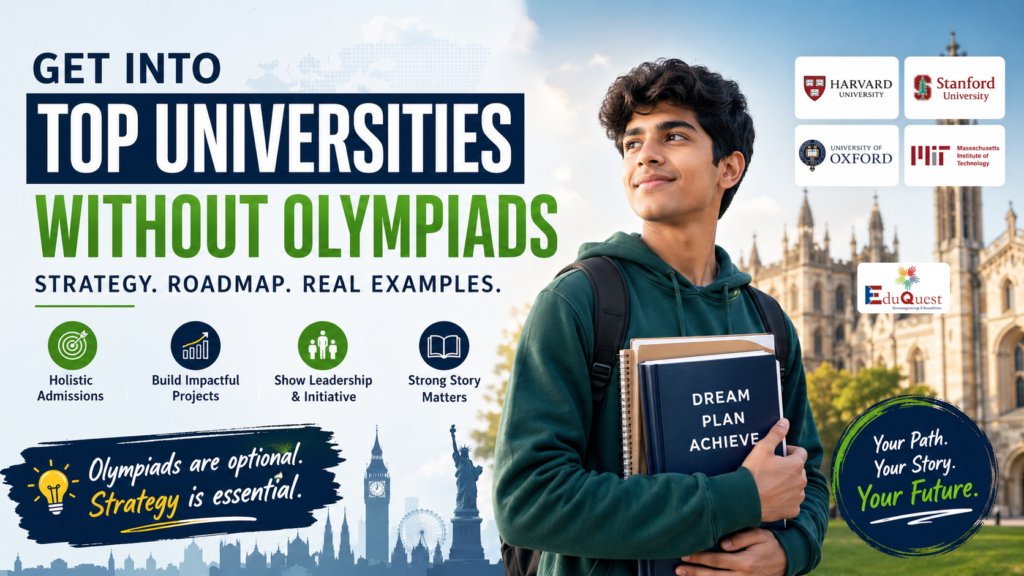
How to Get Into Top Universities Without Olympiads
If you’ve been searching “how to get into top universities without Olympiads”, chances are you’re stuck in a frustrating loop:
- “Everyone says Olympiads are necessary…”
- “But I don’t have medals… did I miss my chance?”
Here’s the reality most students (and even many counselors) misunderstand:
👉 Olympiads are not a requirement for top university admissions.
👉 And having one doesn’t guarantee selection either.
Every year, students get into world-class institutions like Harvard University admissions, Stanford University admissions, and University of Oxford admissions without any Olympiad background. So what’s actually going on?
The Real Problem: Wrong Admission Strategy
Most students in India are told to focus on:
- Marks
- Competitive exams
- Certificates
But top global universities evaluate something very different:
👉 They don’t select the most “decorated” student. They select the most “compelling” student.
This is where the gap begins:
- Students work hard → but on the wrong things
- Profiles look similar → so no one stands out
- Effort increases → results don’t
And that’s exactly why many deserving students get rejected—even with strong achievements.
What This Guide Will Help You Do
This is not another generic blog with random tips. By the end of this guide, you’ll understand:
- ✔️ What top universities actually look for
- ✔️ Whether Olympiads really matter (with data)
- ✔️ How to build a strong profile without competitions
- ✔️ A step-by-step strategy to stand out globally
A Quick Reality Check (Before We Go Deeper)
Let’s make one thing clear: There are two types of applicants to top universities:
| Type | Approach | Outcome |
|---|---|---|
| ❌ Random Effort Students | Follow trends (Olympiads, certificates) | Inconsistent results |
| ✅ Strategic Students | Build focused, high-impact profiles | Higher acceptance chances |
👉 This guide is about helping you become the second type.
If You’re Starting Without Olympiads… You’re Not Behind
In fact, you may have an advantage. Why? Because instead of competing in a narrow path, you can:
- Build real-world projects
- Show leadership
- Create a unique personal story
👉 These are the exact signals top universities value most.
If you want structured guidance on this, explore profile building for top universities to understand how students strategically build standout applications.
Do You Need Olympiads to Get Into Top Universities? (Reality + Data)
Let’s answer the question directly:
👉 No, you do NOT need Olympiads to get into top universities.
But that answer alone isn’t enough—you need to understand why.
What Top Universities Actually Say (Not What People Assume)
Top institutions consistently emphasize one thing:
👉 They follow a holistic admissions process
This means:
- No single achievement (including Olympiads) guarantees admission
- No missing achievement automatically disqualifies you
Instead, they evaluate: Academic strength, Intellectual curiosity, Initiative & impact, and Personal character.
Myth vs Reality (Clear Breakdown)
| Myth | Reality |
|---|---|
| Olympiads are required for Ivy League | ❌ Not required |
| Only toppers get into top universities | ❌ Not true |
| More certificates = better chances | ❌ Weak strategy |
| One big achievement guarantees selection | ❌ No single factor decides admission |
👉 What actually matters is how your entire profile comes together.
What Top Universities Actually Look For in Applicants
Now that we’ve cleared the biggest myth, let’s shift to what really matters:
👉 Top universities don’t ask, “Did you win an Olympiad?”
👉 They ask, “Are you someone we want on our campus?”
Institutions like Harvard University admissions, Stanford University admissions, and University of Oxford admissions evaluate applicants using a multi-dimensional framework. This is where most students lose clarity—because they optimize for one achievement instead of the full profile.
Let’s break down the 5 factors that actually decide your admission.
1. Academic Excellence (Your Foundation Layer)
This is non-negotiable. Top universities expect:
- Strong grades (Class 9–12)
- Subject alignment with your intended major
- Academic rigor (challenging coursework)
👉 But here’s the nuance: They’re not looking for perfect students. They’re looking for consistent, intellectually engaged students.
2. Extracurricular Depth (Not Quantity)
This is where differentiation begins. Most students do 8–10 activities with no depth. Top universities prefer 2–4 activities with long-term commitment and clear progression.
| Weak Profile | Strong Profile |
|---|---|
| Attended 10 competitions | Built and scaled 1 initiative |
| Certificates | Measurable outcomes |
| Short-term involvement | Long-term commitment |
3. Leadership & Initiative (High-Weight Factor)
Leadership is often misunderstood. You don’t need a school captain title; you need initiative, ownership, and responsibility.
- Starting something from scratch
- Solving a problem
- Taking decisions / Influencing outcomes
4. Projects & Real-World Work (Your Olympiad Alternative)
This is the most powerful substitute for Olympiads because projects show application of knowledge and problem-solving.
| Interest Area | Strong Project |
|---|---|
| Business | Launching a small startup |
| Tech | Building an app or tool |
| Social Impact | Running a community initiative |
| Writing | Publishing a niche blog |
5. Personal Story & Essays (Final Decision Layer)
This is where most applications are won—or lost. Universities evaluate your motivation, journey, and future direction.
| Weak Narrative | Strong Narrative |
|---|---|
| “I participated in activities” | “I solved a problem that led me here” |
| No connection / Generic | Clear journey / Personal & specific |
What Separates Accepted vs Rejected Students
| Rejected Students | Accepted Students |
|---|---|
| Random activities | Aligned profile |
| Certificate-driven | Impact-driven |
| No clear direction | Strong narrative |
| Copy others | Build uniqueness |
📌 Internal Strategy Tip: If you want to build a profile aligned with these factors, explore profile building for top universities.
Admission Criteria of Top Universities (Without Olympiads)
Now let’s make this practical. You’ve understood what universities value—but how does that actually differ across top institutions? Because here’s the truth:
👉 Not all top universities evaluate students in the same way
👉 But none of them require Olympiads
This section gives you a real-world benchmark so you can align your strategy accordingly.
University-Level Breakdown (What They Actually Look For)
| University | Olympiad Required? | What They Value Most | Key Insight |
|---|---|---|---|
| Harvard University admissions | ❌ No | Leadership + Impact + Personality | “Whole person” evaluation |
| Stanford University admissions | ❌ No | Innovation + Initiative | Builders & creators stand out |
| Massachusetts Institute of Technology admissions | ❌ No (but valued) | Academic curiosity + problem-solving | Projects > medals |
| University of Oxford admissions | ❌ No | Academic depth + subject mastery | Strong academics matter most |
| University of Cambridge admissions | ❌ No | Analytical thinking + subject passion | Super-curriculars are key |
| University of Toronto admissions | ❌ No | Academics + extracurricular balance | Consistency wins |
| National University of Singapore admissions | ❌ No | Academic strength + achievements | Well-rounded excellence |
Key Pattern You Should Notice
Across all these universities:
- ❌ None say: “Olympiad is mandatory”
- ✅ All say: “Show us who you are and what you’ve done with your interests”
👉 That’s a massive shift in thinking.
USA vs UK: Important Strategic Difference
Many students treat all universities the same—that’s a mistake.
🇺🇸 US Universities (Holistic System)
Examples: Harvard University admissions, Stanford University admissions
They focus on:
- Academics
- Extracurriculars
- Leadership
- Essays
- Personality
🇬🇧 UK Universities (Academic-Focused)
Examples: University of Oxford admissions, University of Cambridge admissions
They focus on:
- Academic performance
- Subject depth
- Super-curriculars (beyond syllabus learning)
Where Olympiads Fit Into This
Let’s be precise—not emotional.
| Scenario | Impact |
|---|---|
| Applying to MIT / STEM-heavy programs | ✅ Helpful (but not required) |
| Applying to US holistic universities | ➖ Minor boost |
| Applying to UK universities | ➖ Relevant only if subject-aligned |
| No Olympiad but strong profile | ✅ Still highly competitive |
What You Should Focus On Instead (University-Aligned Strategy)
If Targeting US Universities:
- Build leadership + projects
- Show initiative
- Craft strong essays
If Targeting UK Universities:
- Focus on subject depth
- Read beyond syllabus
- Build “super-curricular” proof
If Targeting Top Global Mix:
Combine both:
- Strong academics
- 1–2 deep projects
- Clear narrative
Example: Two Students, Two Strategies
Student A (Olympiad-Focused)
- 2 Olympiads
- Strong academics
- No leadership
- No projects
Student B (Strategic Profile)
- Strong academics
- Built a project (e.g., startup/app)
- Leadership experience
- Clear story
Internal Strategy Tip
If you’re unsure how to align your profile based on university type, explore profile building for top universities .
This helps you:
- Choose the right strategy (US vs UK)
- Build aligned projects
- Position your application effectively
Key Takeaway (This Changes Your Approach)
❌ Don’t chase “what looks impressive”
✅ Build “what aligns with your target universities”
That’s how top applicants think.
What Comes Next
Now you clearly understand:
- Different universities → different expectations
- Olympiads are optional everywhere
- Strategy must be aligned—not random
👉 The next step is the most important:
How do you actually build this kind of profile from scratch?
In the next section, we’ll break down:
- A proven step-by-step strategy
- What to focus on (and what to ignore)
- How to stand out without Olympiads
Let’s move into execution mode.
How to Get Into Top Universities Without Olympiads (Step-by-Step Strategy)
Now we move from theory → execution. You already know Olympiads are optional, universities care about your overall profile, and different countries value different things.
👉 What should YOU actually do—step by step—to build a winning profile?
This framework is what successful applicants consistently follow.
Step 1: Start With Clarity (Direction Before Action)
Most students jump into activities without a clear goal. That leads to random certificates, no story, and weak positioning.
Top applicants do the opposite:
👉 They decide who they want to become before they decide what to do.
| No Clarity | With Clarity |
|---|---|
| Random competitions | Business-focused activities |
| No direction | Clear academic + extracurricular alignment |
Step 2: Build a “Spike” (Your Core Strength)
Top universities don’t want average students in everything. They want:
👉 One strong area + decent performance elsewhere. This is called a “spike.”
| Student Type | Outcome |
|---|---|
| Good at everything | Forgettable |
| Exceptional in one area | Memorable |
Step 3: Build High-Impact Projects (Your Olympiad Alternative)
This is the most powerful move you can make. Instead of competing, you create.
👉 Projects show initiative + real-world ability.
| Interest | Project Example |
|---|---|
| Business | Start a small brand or e-commerce store |
| Tech | Build an app / AI tool |
| Social Impact | Launch a community initiative |
| Psychology | Conduct research + publish findings |
| Writing | Build a niche blog |
Step 4: Use the Extracurricular Depth Model
Stop doing everything. Start doing the right things deeply.
| Level | Meaning |
|---|---|
| Participation | You joined |
| Contribution | You added value |
| Leadership | You led or created |
👉 Your goal: Reach Leadership Level.
Step 6: Position Your Story (Most Underrated Step)
Even strong profiles fail because they are poorly presented. Universities evaluate not just what you did, but why you did it.
Step 7: Align Everything Into One Coherent Profile
This is where top students win. Everything should connect: Academics, Activities, Projects, Leadership, and Story.
👉 This creates a coherent application.
Internal Strategy Support (Optional but Powerful)
If you want help executing this framework, explore:
This helps you: Choose the right direction, build projects strategically, and track progress to improve consistently.
Quick Action Plan (Start Today)
If you want immediate progress, follow these steps:
- ✓ Choose 1 interest area
- ✓ Start 1 small project
- ✓ Commit to 1 activity long-term
- ✓ Track your progress weekly
- ✓ Seek feedback and improve
Key Takeaway
❌ Olympiads = one path (high risk)
✅ Strategy = multiple paths (higher success rate)
What Comes Next
Now you have a clear strategy, a step-by-step execution plan, and a framework used by successful applicants.
👉 But you might still be thinking: “Does this actually work in real life?”
In the next section, we’ll show:
- Real student examples
- Profiles that got into top universities
- What they did differently
Let’s move from strategy → proof.
Real Examples: Students Who Got Into Top Universities Without Olympiads
At this point, you understand the strategy. But let’s address the real doubt: “Does this actually work in real life?”
Yes—and not just occasionally. Every year, students get into top institutions like Harvard University admissions, Stanford University admissions, and University of Oxford admissions without Olympiad medals—by building strong, strategic profiles.
Case Study 1: The “Builder” Profile (Business/Entrepreneurship)
🎯 Target: US Top Universities
📊 Academics: Strong (85–92%)
❌ Olympiads: None
🚀 What They Did: Started a small e-commerce brand in Class 10, scaled to ₹1.5–2 lakhs revenue, and built a team of 3–4 students.
📌 Insight: Revenue + execution = stronger than certificates.
Case Study 2: The “Tech Creator” Profile
🎯 Target: STEM programs
📊 Academics: Strong in Math & Science
❌ Olympiads: None
🚀 What They Did: Built a productivity app for students, reached ~2,000+ users, and continuously improved features based on feedback.
📌 Insight: Building something useful > solving theoretical problems.
Case Study 3: The “Academic Depth” Profile (UK Focus)
🎯 Target: Oxford / UK universities
📊 Academics: Excellent
❌ Olympiads: None
🚀 What They Did: Read advanced books beyond syllabus, completed university-level courses, and wrote analytical essays on subject topics.
📌 Insight: For UK, depth > diversity.
Case Study 4: The “Social Impact Leader” Profile
🎯 Target: US holistic universities
📊 Academics: Good
❌ Olympiads: None
🚀 What They Did: Started a community awareness initiative reaching 500+ students and led a team to collaborate with local NGOs.
📌 Insight: Impact-driven work stands out strongly in holistic admissions.
Common Pattern Across All These Students
Let’s simplify what actually worked. This is not a coincidence—it’s a pattern:
| Factor | Present in All Cases |
|---|---|
| Olympiads | ❌ Not present |
| Strong academics | ✅ Yes |
| Projects / initiatives | ✅ Yes |
| Leadership | ✅ Yes |
| Clear direction | ✅ Yes |
| Strong Story | ✅ Yes |
What Made Them Stand Out (Real Differentiation)
These students didn’t try to compete with everyone, collect certificates, or follow trends. Instead, they:
- Built something meaningful
- Stayed consistent
- Focused on impact
Why Most Students Still Don’t Follow This Path
Even after seeing examples, many students hesitate because of doubts like: "What if my project fails?" or "What if this is not enough?"
👉 So they go back to safe options, competitions, and copying others.
Internal Strategy Insight
If you’re unsure what kind of project or profile to build, explore profile building for top universities .
This helps you choose the right project, build measurable impact, and align everything with admissions.
Key Takeaway
❌ You don’t need Olympiads to prove your ability.
✅ You need proof of initiative, impact, and growth.
That’s what these students demonstrated—and that’s what got them selected.
What Comes Next
Now you’ve seen real examples, proven patterns, and what actually works.
👉 The next step is: How do YOU apply this in a structured, time-bound way?
In the next section, we’ll break down:
- A clear roadmap (Class 8–12)
- When to do what
- How to stay consistent
Let’s turn strategy into a timeline you can follow.
Step-by-Step Roadmap for Indian Students (Class 8–12)
Now comes the most practical part: 👉 When should you do what—so you actually build a strong profile in time?
Because here’s the truth: Strategy without timing is wasted effort, and a late start leads to unnecessary pressure.
Exploration & Foundation (Class 8–9)
This is your advantage phase—most students waste it. 🎯 Focus: Self-discovery, Skill building, and Exposure.
| Area | Action |
|---|---|
| Career Clarity | Explore different fields (Business, Tech, Psychology, etc.) |
| Skills | Start basics (communication, writing, coding, research) |
| Activities | Try 2–3 different extracurriculars |
| Reading | Go beyond school syllabus |
📌 Goal: Find direction—not perfection.
Direction + First Projects (Class 10)
Now you stop exploring randomly and start building intentionally. 🎯 Focus: Choosing your domain and starting your first project.
| Area | Action |
|---|---|
| Domain | Select 1–2 core interests |
| Project | Start a small initiative (e.g., store, app, website) |
| Academics | Strengthen subject performance |
| Tracking | Document everything you do |
📌 Goal: Move from “interest” → to “action”.
Deep Work + Leadership (Class 11)
This is the most important year—most successful applicants are built here. 🎯 Focus: Scaling your work and taking leadership.
| Area | Action |
|---|---|
| Projects | Expand and improve your initiative |
| Leadership | Lead a team / take ownership |
| Internships | Gain real-world exposure |
| Achievements | Participate selectively (aligned only) |
📌 Goal: Show growth + impact.
Applications & Positioning (Class 12)
Now everything comes together. 🎯 Focus: Applications, Essays, and Final polish.
| Area | Action |
|---|---|
| Essays | Build a strong personal narrative |
| Applications | Shortlist universities strategically |
| Testing | Finalize SAT preparation strategy |
| Profile | Present achievements clearly |
📌 Goal: Position your work effectively.
Visual Timeline (Simplified)
| Class | Focus |
|---|---|
| 8–9 | Explore + build skills |
| 10 | Choose direction + start project |
| 11 | Deep work + leadership |
| 12 | Applications + storytelling |
Weekly Execution System (What Actually Keeps You Consistent)
Most students fail not because of lack of strategy… 👉 But because they don’t follow a system.
Ideal Weekly Structure:
- Weekdays: Academics + skill building
- Weekends: Project work + research
- Weekly Review: Track progress
Example Plan:
- 1–2 hrs/day → Academics
- 1 hr/day → Skill building
- 4–6 hrs/week → Project
Monthly Progress Tracking (What Top Students Do Differently)
You need to measure growth. Track these metrics monthly:
| Area | Metric |
|---|---|
| Academics | Grade improvement |
| Projects | Output / impact |
| Skills | New skills learned |
| Leadership | Responsibilities taken |
📌 Rule: If nothing improves monthly → your strategy needs fixing.
Common Mistakes in Execution
- Starting too late (Class 11–12)
- Doing random activities
- Not documenting work
- Ignoring consistency
- Over-focusing on competitions
Internal Support (If You Want Structure)
If you want a guided roadmap instead of figuring everything out yourself, explore profile building for top universities.
Key Takeaway
❌ Last-minute effort doesn’t work.
✅ Long-term structured execution does.
If you follow this roadmap, you don’t need Olympiads—you build something far more powerful.
What Comes Next
Now you have a clear timeline, a phase-wise strategy, and a robust execution system.
👉 But one more thing can still hold you back:
Mistakes that silently ruin your chances.
In the next section, we’ll break down:
- Why most students fail (even with hard work)
- The specific traps to avoid in your profile
- How to stay ahead of the global competition
Let’s make sure you don’t fall into those traps.
Why Most Students Fail (Even Without Olympiads)
At this stage, the strategy is clear. You know:
- Olympiads are optional
- What universities actually value
- How to build a strong profile
- When to do what
And yet…
👉 Most students still don’t get into top universities
Why? Because success here is not just about knowing the strategy—it’s about avoiding the mistakes that quietly destroy your chances.
1. Chasing Certificates Instead of Building Impact
This is the most common mistake. Students believe: “More certificates = stronger profile”
So they:
- Join multiple competitions
- Collect participation awards
- Add everything to their resume
❌ Problem:
- No depth
- No real achievement
- No differentiation
✅ What Works Instead:
- 1–2 strong projects
- Measurable outcomes
- Real-world impact
📌 Insight:
👉 Universities don’t count certificates
👉 They evaluate impact
2. Copying “Successful” Profiles
Students often look at:
- “Harvard student profile” videos
- Toppers’ achievements
- Online examples
…and try to copy them.
❌ Problem:
- No originality
- No personal direction
- Weak narrative
Reality from Harvard University admissions:
👉 They are not selecting clones—they are selecting individuals
✅ What Works Instead:
- Build based on your interests
- Create your own path
- Focus on authenticity
📌 Insight:
👉 Copying reduces your chances more than having no strategy
3. Starting Too Late (Critical Timing Mistake)
Many students wake up in:
- Class 11
- Or worse, Class 12
❌ Problem:
- No time to build depth
- Projects look rushed
- Profile feels incomplete
Reality:
Strong profiles take 2–3 years to build
✅ What Works Instead:
- Start early (Class 8–10 ideally)
- Build gradually
- Show progression over time
📌 Insight:
👉 Time is a competitive advantage
4. No Clear Direction (Scattered Profile)
This is a silent killer. Students:
- Do random activities
- Switch interests frequently
- Lack a clear goal
❌ Problem:
- No coherence
- Weak story
- Confused application
| Weak Profile | Strong Profile |
|---|---|
| Debate + coding + dance (random) | Business-focused activities |
| No connection | Clear theme |
✅ What Works Instead:
- Choose 1–2 core interests
- Align everything with it
- Build a consistent narrative
📌 Insight:
👉 Clarity creates coherence—and coherence gets selected
5. Ignoring Essays & Storytelling
This is where even strong students fail. They think: “My achievements will speak for themselves”
They don’t.
❌ Problem:
- Generic essays
- No emotional connection
- Weak positioning
What universities like Stanford University admissions evaluate:
- Your mindset
- Your journey
- Your perspective
✅ What Works Instead:
- Clear “why” behind your actions
- Personal growth story
- Strong narrative linking everything
📌 Insight:
👉 Profile gets attention
👉 Story gets selection
6. Lack of Consistency (Biggest Execution Failure)
Students often:
- Start strong
- Lose momentum
- Quit projects midway
❌ Problem:
- No long-term commitment
- No visible growth
- Weak impact
✅ What Works Instead:
- Weekly execution system
- Monthly tracking
- Long-term commitment
📌 Insight:
👉 Consistency beats talent in admissions
7. Doing Everything Alone (Without Guidance)
Let’s be realistic. Students struggle with:
- What project to choose
- How to show impact
- How to connect profile elements
❌ Result:
- Trial and error
- Wasted time
- Missed opportunities
✅ What Works Instead:
- Structured guidance
- Clear roadmap
- Feedback and correction
👉 If you want to avoid these mistakes, explore:
profile building for top universities
Quick Summary: Mistakes vs Smart Strategy
| Mistake | Smart Approach |
|---|---|
| Certificates focus | Impact focus |
| Copying others | Building uniqueness |
| Late start | Early planning |
| Random activities | Aligned profile |
| Ignoring essays | Strong storytelling |
| Inconsistency | Structured execution |
Key Takeaway
❌ Most students fail because of avoidable mistakes
✅ Successful students win because of strategic execution
If you avoid these mistakes: 👉 You automatically move ahead of 80–90% applicants
What Comes Next
Now you know:
- What to do
- When to do it
- What NOT to do
👉 The next step is: How to actually build a strong, winning profile from scratch
In the next section, we’ll break down:
- Exact profile-building framework
- How to connect all elements
- How to stand out in applications
Let’s move to final execution.
How to Build a Strong Profile for Top Universities (Complete Framework)
By now, you’ve seen:
- What top universities value
- Real examples that worked
- The roadmap and common mistakes
Now let’s bring everything together into one system:
👉 How do you actually build a “top university level” profile from scratch?
Because here’s the truth:
- Random effort → weak profile
- Hard work alone → not enough
- Strategy + structure → results
This section gives you a complete, repeatable framework.
The 4-Layer Profile Building System
A strong application is not built in one dimension. It’s built across four connected layers:
| Layer | Purpose | What It Shows |
|---|---|---|
| Academics | Foundation | Discipline + capability |
| Activities | Engagement | Interest + consistency |
| Projects | Differentiation | Initiative + impact |
| Story | Positioning | Clarity + personality |
👉 Most students focus only on 1–2 layers.
👉 Top students optimize all four together.
Layer 1: Academics (Your Base Signal)
Top universities like University of Oxford admissions and University of Cambridge admissions place strong emphasis on academics.
What You Need:
- Consistent grades (not necessarily perfect)
- Subject alignment with your intended major
- Strong performance in key subjects
Strategic Tip:
- If you want to study Economics → focus on Math
- If STEM → strong Science + Math
- If Humanities → strong writing + analysis
📌 Insight:
👉 Academics won’t make you stand out
👉 But weak academics will eliminate you
Layer 2: Activities (Consistency Over Time)
Activities show:
- Commitment
- Interest
- Growth
But only if done right.
❌ Weak Approach:
- 8–10 unrelated activities
- Short-term participation
✅ Strong Approach:
- 2–4 aligned activities
- Long-term involvement
- Clear progression
| Weak | Strong |
|---|---|
| Joined many clubs | Led one initiative |
| No impact | Clear contribution |
| Short-term | Multi-year involvement |
📌 Insight:
👉 Activities should support your direction—not distract from it
Layer 3: Projects (Your Differentiation Engine)
This is where your profile becomes powerful. Projects show:
- Initiative
- Real-world thinking
- Problem-solving
What Top Universities Prefer:
Over competitions, institutions like Stanford University admissions value students who build and create.
What a Strong Project Includes:
- Clear purpose
- Execution
- Measurable impact
| Project Type | What Makes It Strong |
|---|---|
| Startup | Revenue + users |
| App | Downloads + engagement |
| Social Initiative | People impacted |
| Blog | Audience growth |
📌 Insight:
👉 Projects turn your profile from “good” → “memorable”
Layer 4: Story (The Final Multiplier)
This is where everything connects. Even a strong profile can fail without a clear story.
Universities like Harvard University admissions evaluate:
- Why you chose your path
- How you’ve grown
- What drives you
Your Story Must Show:
- Direction
- Motivation
- Growth
❌ Weak:
“I participated in activities”
✅ Strong:
“I explored X, discovered Y problem, and built Z to solve it”
📌 Insight:
👉 Your story gives meaning to your achievements
How to Combine All 4 Layers (Winning Formula)
Here’s what a strong profile actually looks like:
- Academics aligned with interest
- Activities supporting that interest
- Projects showing real-world application
- Leadership demonstrating growth
- Story connecting everything
👉 This creates a coherent and compelling application
Profile Building Example (Complete View)
🎯 Student Target: Business
| Layer | Example |
|---|---|
| Academics | Strong Math + Commerce |
| Activities | Business club (long-term) |
| Project | Started small e-commerce brand |
| Leadership | Led team / scaled operations |
| Story | Passion for entrepreneurship from real experience |
👉 This profile is:
- Focused
- Logical
- Memorable
Internal Support (If You Want a Structured System)
If you want to build this kind of profile with proper guidance, explore profile building for top universities .
This helps you:
- Build each layer strategically
- Avoid common mistakes
- Stay consistent and focused
Key Takeaway
❌ Admissions is not about one big achievement
✅ It’s about a well-structured, aligned profile
If you build all 4 layers properly: 👉 You don’t need Olympiads 👉 You become a strong global applicant
What Comes Next
Now you understand:
- The complete profile-building framework
- How to connect all elements
- What makes a strong application
👉 Let’s finish strong.
FAQs: Getting Into Top Universities Without Olympiads
This section is designed to answer the exact questions students search on Google—which also helps this page rank for featured snippets.
Yes. Top universities like Harvard University admissions and Stanford University admissions do not require Olympiads. They follow a holistic admissions process, which means they evaluate:
- Academics
- Extracurriculars
- Leadership
- Personal story
👉 Many successful applicants have zero Olympiad background but strong overall profiles.
Several factors carry more weight than Olympiads:
- Consistent academic performance
- Extracurricular depth (not quantity)
- Leadership and initiative
- Real-world projects
- A clear personal narrative
👉 These elements together form a compelling application, which matters more than any single achievement.
Indian students can stand out by focusing on:
- Building passion projects (startup, app, research, blog)
- Showing leadership in activities
- Demonstrating impact and growth over time
- Creating a clear, focused profile
👉 Instead of competing, focus on creating and contributing.
No, they don’t prefer Olympiad winners—they value strong overall applicants. At universities like Harvard University admissions:
- Olympiads may act as a bonus
- But they are not a deciding factor
👉 A student with strong academics, leadership, and projects can outperform an Olympiad winner with a weak profile.
The SAT is not always mandatory, but it can be a strong supporting factor, especially for international students. A good score can strengthen your academic credibility and balance weaker areas. 👉 If you’re planning to take it, explore SAT preparation strategy.
Ideally:
- Start in Class 8–9 (best scenario)
- Class 10 is still a strong starting point
- Class 11 requires focused execution
- Class 12 is mostly for applications
👉 The earlier you start, the more time you have to build depth and impact.
Your project should align with your interests:
- Business → Start a small venture
- Tech → Build an app or tool
- Social Impact → Run a community initiative
- Writing → Create a blog or publication
👉 Focus on execution, growth, and measurable results.
Yes. Universities like University of Oxford admissions focus more on academic performance, subject depth, and super-curricular learning. Olympiads are not required, but subject understanding is critical.
The biggest mistakes include:
- Chasing certificates instead of impact
- Copying others’ profiles
- Starting too late
- Ignoring essays and storytelling
- Lack of consistency
👉 Avoiding these mistakes already puts you ahead of most applicants.
Start with these simple steps:
- Choose one interest area
- Start one small project
- Commit to one activity long-term
- Track your progress and improve consistently
👉 If you want structured guidance, explore profile building for top universities.
Start Your Admission Journey the Right Way
You’ve gone through everything that actually matters:
- The truth about Olympiads
- What top universities really evaluate
- A proven strategy framework
- Real examples that worked
- A step-by-step roadmap
- Common mistakes to avoid
Now there’s only one question left:
👉 What are you going to do with this information?
Because reading alone won’t change your outcome. Execution will.
Your Next 3 Steps (Do This Immediately)
If you want to move forward without confusion, start here:
✅ Step 1: Choose Your Direction
- Identify 1–2 interest areas
- Stop following random trends
- Start thinking long-term
✅ Step 2: Start Your First Project
- Don’t overthink
- Start small
- Focus on execution
👉 Remember: A small project started today is more powerful than a “perfect plan” delayed.
✅ Step 3: Build Consistency
- Follow a weekly system
- Track progress
- Improve continuously
👉 This is what separates serious applicants from everyone else.
If You Want to Fast-Track This Process
Let’s be practical. Most students struggle with: what project to start, how to build real impact, and how to align everything for admissions.
That’s where structured guidance helps.
👉 Explore: study abroad profile building
This gives you:
- A clear roadmap
- Personalized strategy
- Execution support
- Application positioning
Talk to an Expert (Get Clarity Faster)
Sometimes, one conversation can save months of confusion. If you want direct guidance:
👉 WhatsApp: 9958041888
👉 Or connect here: study abroad guidance
Final Takeaway
Let’s simplify everything into one powerful truth:
❌ Olympiads are optional
✅ Strategy is essential
Students who get into top universities are not the most decorated or "perfect"—they are:
- The most focused
- The most consistent
- The most strategic
Your Advantage Starts Now
You now have clarity most students don’t, a roadmap most students never follow, and a strategy that actually works.
👉 If you take action now, you’re already ahead.
Don’t just read—start building.
Your journey to a top global university begins with a single strategic step. Take that step today.
Expert guidance. Structured roadmap. Proven results.