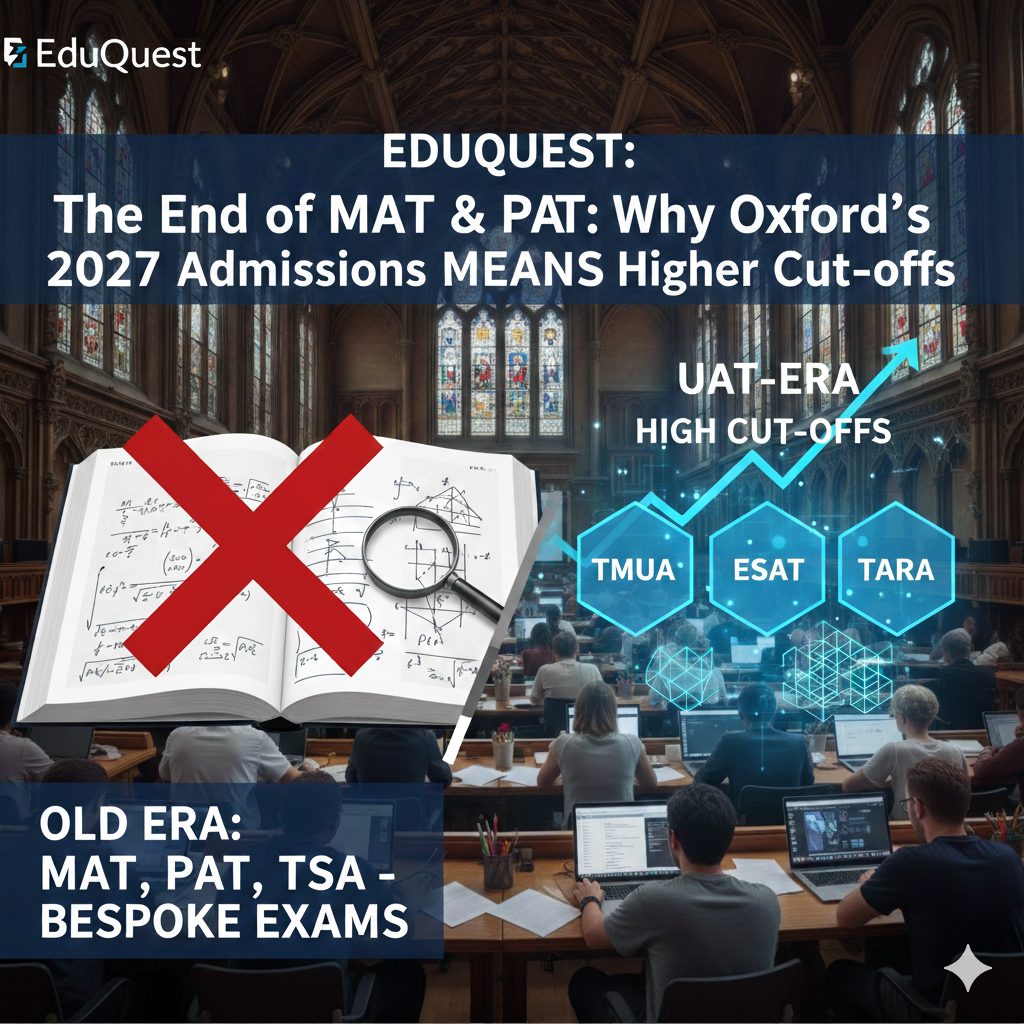
The University of Oxford has officially confirmed the most significant overhaul to its undergraduate admissions process in decades. For students targeting the 2027 intake, the legendary, bespoke “in-house” exams that defined the Oxbridge experience—including the MAT, PAT, TSA, MLAT, and CAT—are officially over. In their place, Oxford has joined the UAT-UK alliance alongside Cambridge and Imperial, adopting the TMUA, ESAT, and TARA as the new gold standards for entry. While this move toward standardized, computer-based testing via Pearson VUE is designed to reduce “exam fatigue,” the strategic reality for applicants is much more intense. With a single test score now shared across the entire G5 landscape, the data is perfectly comparable, meaning interview cut-off scores are projected to skyrocket. At EduQuest, we’ve analyzed this shift from “deep derivation” to “logical quick judgment,” and we are already helping the next generation of scholars navigate this high-stakes global race.
The Great Admissions Shake-up: Oxford Scraps MAT, PAT, TSA – What 2027 Applicants Need to Know (and How EduQuest Leads the Way)
Are you aiming for Oxford, Cambridge, or Imperial in 2027? If so, brace yourself for the biggest admissions transformation in decades. The University of Oxford has officially retired its suite of bespoke entrance exams – the MAT, PAT, TSA, MLAT, and CAT – starting with the 2026 application cycle (for 2027 entry). This isn’t just a minor tweak; it’s a fundamental shift, replacing legacy tests with a unified, standardized framework: the UAT-UK, in collaboration with Cambridge and Imperial.
At EduQuest, we’ve been at the forefront of this change, analyzing every data point and preparing our students for what we call the “Global Race.” The era of highly specialized, university-specific tests is over. The era of standardized excellence has begun.
Why the Change? Oxford’s Vision for 2027
Oxford’s decision reflects a broader trend towards streamlining admissions and enhancing accessibility. The previous system, while rigorous, often required students to prepare for multiple, distinct exams depending on their university choices. This could create undue stress and a logistical burden. By aligning with the UAT-UK framework, Oxford aims to:
-
Simplify the Application Process: Reduce the number of unique tests students need to take.
-
Standardize Assessment: Create a more consistent and comparable metric for evaluating candidates across top institutions.
-
Enhance Accessibility: Potentially ease the preparation burden for international applicants or those without access to highly specialized tutoring for every single test.
The New Unified Landscape: TMUA, ESAT, TARA
For 2027 entry, students targeting the UK’s most elite universities (often referred to as the “G5” – Oxford, Cambridge, Imperial, LSE, UCL) will now encounter three core computer-based assessments:
-
TMUA (Test of Mathematics for University Admission):
-
Replaces (Oxford): Primarily the MAT (Mathematics Admissions Test).
-
Primary Subjects: Mathematics, Computer Science, Economics.
-
Focus Area: Emphasizes logical reasoning, problem-solving, and the ability to apply mathematical concepts quickly and accurately. It assesses core mathematical knowledge from A-level Mathematics (or equivalent) with a focus on problem-solving under time pressure.
-
-
ESAT (Engineering and Science Admissions Test):
-
Replaces (Oxford): Primarily the PAT (Physics Aptitude Test) and the BMSAT (Biomedical Sciences Admissions Test).
-
Primary Subjects: Engineering, Physics, Natural Sciences, Medicine (for some institutions).
-
Focus Area: Designed to test scientific and mathematical aptitude, critical thinking, and problem-solving skills relevant to STEM disciplines. Candidates typically choose modules in Maths, Physics, Chemistry, and Biology.
-
-
TARA (Test of Academic Reasoning for Admissions):
-
Replaces (Oxford): Primarily the TSA (Thinking Skills Assessment).
-
Primary Subjects: PPE (Philosophy, Politics, and Economics), E&M (Economics and Management), Human Sciences, Psychology, History, Law (for some institutions).
-
Focus Area: Assesses critical thinking, logical reasoning, and verbal reasoning skills. It evaluates a candidate’s ability to analyze arguments, draw conclusions, and solve problems using textual and numerical data, mirroring the intellectual demands of humanities and social science degrees.
-
Crucial Application Rule: While the tests are standardized, the long-standing Oxford and Cambridge rule remains – you cannot apply to both in the same admissions cycle. Furthermore, if you are applying to Oxford or Cambridge, you MUST sit the relevant UAT-UK test in the October test window. Missing this deadline will effectively close your application for 2027 entry.
The “Relaxed” Reality: Less Exam Fatigue, More Strategic Focus
The most immediate and welcomed benefit for applicants is the “One-and-Done” approach to admissions testing. In previous cycles, a student applying for Mathematics at both Oxford and Imperial might have faced preparing for the MAT (Oxford’s bespoke test) and the TMUA (Imperial’s preferred test) – two distinct formats, often within the same high-pressure month.
For 2027, this stress is largely eliminated. If your target courses at Oxford, Cambridge, and Imperial all require the TMUA, you take the TMUA once, and that score is used across all applications. This allows for:
-
Focused Preparation: Students can dedicate their energy to mastering a single test format and its unique question styles.
-
Reduced Logistical Burden: No more juggling multiple registration deadlines, test centers, or differing exam conditions.
-
Earlier Strategic Planning: With a standardized framework, students and educators can begin targeted preparation earlier, without waiting for university-specific test specifications.
The “High Cut-off” Risk: The Competitive Spike
While convenience is a major advantage, this standardization introduces a new, intense competitive dynamic: the era of the high cut-off.
-
The Benchmark Shift: When every top applicant from across the globe takes the exact same standardized test (TMUA, ESAT, TARA), the data is perfectly comparable. Admissions tutors will see precise percentile ranks against a vast international pool. This eliminates the “guesswork” of how a score on Oxford’s MAT might compare to a TMUA score from an Imperial applicant.
-
Rising Thresholds: The new tests, particularly the TMUA and ESAT, are often perceived as more “accessible” in their format (e.g., multiple-choice) compared to the more derivation-heavy or essay-based legacy tests. This accessibility, combined with a larger applicant pool taking the same test, means that the scores required to be shortlisted for an interview are expected to rise significantly. A score that was considered “good” or “competitive” in 2025 may only be “average” or “below threshold” for 2027.
-
Accuracy is King: In multiple-choice formats, there is no credit for showing your “working out.” One small error can lead to a completely incorrect answer and a lost mark, which can be critical when distinguishing between hundreds of high-scoring applicants. Precision, speed, and logical consistency are paramount.
How EduQuest Builds Your 2027 “Spike”
At EduQuest, we don’t just react to change; we proactively shape our strategies to empower our students. We understand that the 2027 intake demands a different approach. We are already pivoting our coaching methodologies to meet the rigorous demands of the UAT-UK era:
-
UAT Strategic Mastery: We transition students from “deep theoretical derivation” (characteristic of old MAT/PAT questions) towards the logical agility, rapid problem-solving, and efficient data interpretation required for the computer-based TMUA, ESAT, and TARA. Our programs are designed to build proficiency in these new formats, ensuring speed and accuracy.
-
Profile Integration & Differentiation: With test scores becoming highly clustered at the top, your Academic Profile becomes the critical differentiator. We guide students in cultivating a unique “spike” – whether it’s through developing impressive GitHub projects for Computer Science, engaging in cutting-edge MedTech research for Sciences, or building compelling portfolios for humanities. This demonstrates passion, initiative, and intellectual curiosity beyond the exam hall.
-
The “Interview-Ready” Mindset: Clearing the higher test cut-offs is just the first hurdle. We ensure that once shortlisted, our students are fully prepared for the final, decisive stage: the Oxbridge interview. Our mock interview programs are tailored to develop critical thinking, articulate communication, and the ability to defend and expand upon their ideas, crucial for success in a demanding Oxbridge setting.
The race for 2027 has officially started, and the track has changed. Don’t wait for standard advice to catch up. The proactive application of the right strategy, coupled with deep academic preparation, will be the key to success.
Are you targeting a 2027 seat at Oxford, Cambridge, or Imperial? The transition to standardized testing means your preparation strategy needs to evolve today. Contact EduQuest for a personalized diagnostic session and let us help you build your standardized “spike” – ensuring you’re not just ready for the tests, but ready to stand out.
Learn more about our UAT-UK preparation programs for TMUA, ESAT, and TARA. Visit our website or book a free consultation!