The definitive guide for students aiming for Cambridge, LSE, Warwick, Imperial & more
If you are planning to apply for Mathematics, Economics, or a related degree at a top UK university in 2026, there is a strong chance you will need to sit the Test of Mathematics for University Admission — better known as the TMUA. This exam is no longer just a Cambridge admissions tool; it is now widely used across leading universities and has become one of the most important elements of a competitive university application in quantitative subjects.
Yet many students underestimate the TMUA, treat it as an afterthought, or begin preparation far too late. The result is a score that fails to strengthen — or actively weakens — an otherwise impressive application. This guide exists to make sure that does not happen to you.
Whether you have six months, three months, or just a few weeks before the exam date, this comprehensive TMUA Exam Preparation 2026 guide will walk you through everything you need to know: what the exam tests, how it is scored, which universities use it and why, how to break down the syllabus topic by topic, and exactly how to structure your preparation for maximum impact. We will also cover the most common and costly mistakes students make — and precisely how to avoid them.
By the end of this guide, you will have a clear, actionable understanding of what it takes to achieve a score that puts you in a genuinely competitive position for the UK’s most selective universities.
1. What Is the TMUA and Who Needs It?

A Brief History and Purpose
The Test of Mathematics for University Admission (TMUA) was developed to give universities a standardised, objective measure of mathematical ability beyond A-Level grades. While predicted A-Levels are a useful indicator of academic potential, they do not always differentiate between the very best candidates — particularly in a landscape where A* grades have become increasingly common. The TMUA was designed to fill this gap.
Originally created by Cambridge Assessment Admissions Testing (now Admissions Testing Service), the TMUA assesses not just what students know, but how they think mathematically. It probes their ability to reason under time pressure, apply mathematical logic to unfamiliar problems, and think precisely in ways that mirror the demands of a university mathematics or economics course.
The exam was first introduced in 2017 and has grown significantly in reach. As of 2026, it is accepted or required by a growing list of highly competitive universities across the United Kingdom.
Who Needs to Sit the TMUA in 2026?
The following universities have used the TMUA as part of their admissions process. Requirements can vary by course, and students should always verify directly with individual universities, as policies do change:
| University | Relevant Courses | Usage |
|---|---|---|
| University of Cambridge | Mathematics, Computer Science, Economics, Engineering (some) | Required / Strongly recommended |
| London School of Economics (LSE) | Mathematics & Economics, Mathematics, Statistics | Required |
| University of Warwick | Mathematics, MORSE, Data Science | Required for some courses |
| Imperial College London | Mathematics, Mathematics & Computer Science | Accepted |
| University of Bath | Mathematics, Mathematics & Statistics | Accepted |
| University of Durham | Mathematics, Computer Science | Accepted |
| University of Cardiff | Mathematics | Accepted |
| Lancaster University | Mathematics, Statistics | Accepted |
Important: Always check the specific admissions requirements for your chosen course directly on the university website before finalising your application plans, as TMUA requirements can change from year to year
Official TMUA Website & Test Authority
The TMUA is conducted by the official Admissions Testing Service, and all registrations, updates, and official announcements are managed through their platform.
You should always refer to the official website for:
- Latest exam dates and deadlines
- Registration process
- Test centre details
- Policy updates and changes
Important: Information can change each year, so relying only on third-party sources is risky. Always cross-check with the official site before making decisions.
Why Does the TMUA Matter So Much?
At Cambridge, your TMUA score plays a direct role in whether you are shortlisted for interview. A strong score — typically 6.5 or above — substantially increases your chances of receiving an interview invitation, even if your other application materials are similar to those of other candidates. Conversely, a poor TMUA score can result in a rejection for candidates who might otherwise have been considered.
At LSE, the TMUA is woven into the holistic review process. While there is no single published cut-off, admissions tutors use it alongside A-Level grades and personal statements to identify candidates with the mathematical aptitude to thrive in quantitative programmes.
At universities such as Warwick, Durham, and Bath, a strong TMUA score can serve as a differentiating factor in a field of applicants who all have predicted A*AA or above. It demonstrates not just that you know A-Level content, but that you can think flexibly and rigorously under pressure — exactly the qualities demanded by a university mathematics education.
In short: if you are applying to any of these institutions, the TMUA is not optional. It is a significant competitive lever, and your performance on it will have a direct bearing on your admissions outcome.
2. Exam Format and Scoring System
The Structure of the TMUA
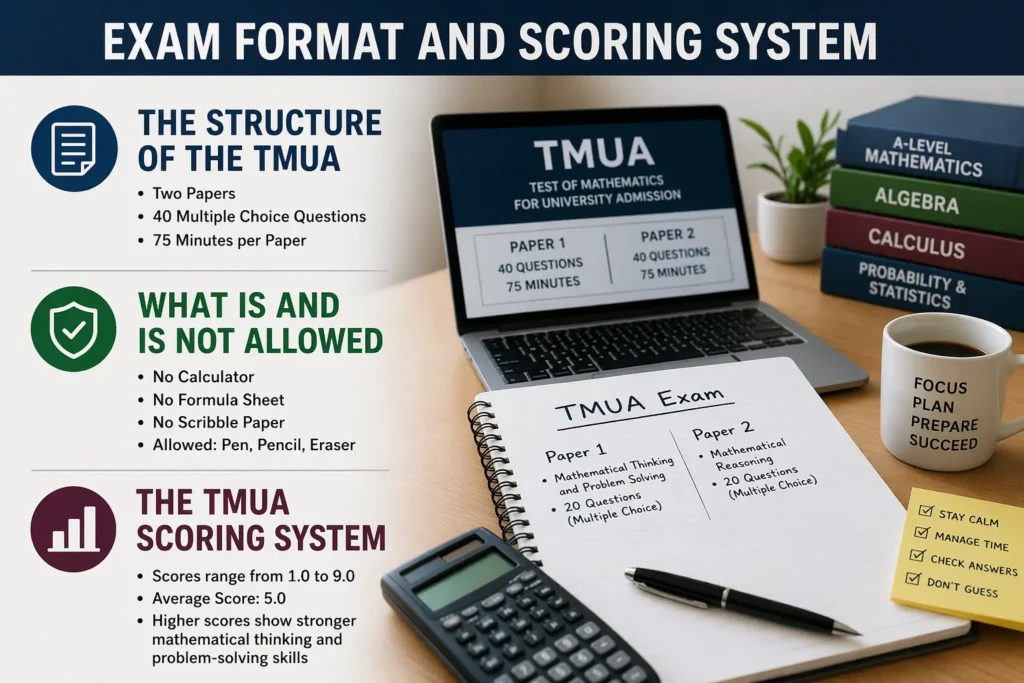
The TMUA consists of two separate papers, each lasting 75 minutes. The two papers are sat on the same day, typically in October, making the full exam a substantial three-hour commitment. Understanding the structure of each paper is the first step in developing an effective preparation strategy.
Paper 1: Mathematical Knowledge
Paper 1 tests your application of mathematical knowledge and techniques. The questions draw on the standard A-Level Mathematics syllabus and require you to use mathematical methods fluently and accurately. The focus is on whether you can execute mathematical procedures reliably and apply them in slightly unfamiliar contexts.
Paper 1 contains 20 multiple-choice questions. Each question offers five answer options, and you must select the single correct answer. There is no partial credit and no negative marking — you either get the mark or you do not. You have 75 minutes to answer 20 questions, which gives you an average of 3 minutes and 45 seconds per question. In practice, some questions can be answered quickly and others require more extended reasoning.
Paper 2: Mathematical Reasoning
Paper 2 is widely regarded as the more demanding of the two. It tests mathematical reasoning, logical thinking, and the ability to construct and evaluate arguments. Paper 2 does not simply ask you to apply techniques — it asks you to think about mathematics itself. Questions may involve assessing the validity of a proof, identifying errors in reasoning, evaluating statistical claims, or applying logic to unfamiliar scenarios.
Like Paper 1, Paper 2 contains 20 multiple-choice questions with five options each and a 75-minute time limit. However, the cognitive demands are considerably higher, and many students find that time pressure is more acute in Paper 2.
What Is and Is Not Allowed
- Calculators: NOT permitted in either paper
- Formula sheets: NOT provided — you are expected to know key formulae
- Pencil and rough paper: Provided at the exam centre
- Dictionaries or other aids: NOT permitted
The absence of a calculator is critically important. Many A-Level students have become reliant on calculators for numerical computation, and the TMUA demands that you be comfortable performing calculations mentally or by hand. This has significant implications for your preparation strategy, which we address in detail in Section 4.
The TMUA Scoring System
The TMUA uses a scaled scoring system rather than a raw percentage mark. Each paper is scored independently on a scale of 1.0 to 9.0, with scores given to one decimal place. A combined average score is also often considered by universities.
The scoring is designed so that the average score is approximately 5.0. This means that a score of 5.0 is genuinely average, and scores above 6.0 represent strong performance. Scores of 7.0 and above are exceptional and place you among the very best candidates nationally.
| Score Range | Classification | Typical Outcome |
|---|---|---|
| 6.5 – 9.0 | Exceptional | Strong advantage at Cambridge, Imperial, LSE |
| 5.5 – 6.4 | Very Strong | Competitive at top universities |
| 4.5 – 5.4 | Good | Meets threshold for most TMUA-requiring courses |
| 3.5 – 4.4 | Average | May not strengthen application significantly |
| Below 3.5 | Below Average | Can weaken application at top institutions |
It is important to understand that the scaled score is not simply a conversion from raw marks. The TMUA uses statistical processes to account for variations in difficulty between different test years. A score of 6.5 in 2026 should represent the same level of ability as a score of 6.5 in 2025, even if the raw mark required to achieve it differs slightly.
Key insight: Getting 14 or 15 questions correct out of 20 in each paper typically puts you in the 6.0–7.0 score range — the zone that makes a real difference to top university applications. This is a useful target to keep in mind during your practice sessions.
Check Your TMUA Score Instantly (Free Calculator)
Understanding the TMUA scoring system in theory is useful — but what really matters is knowing where you currently stand.

To make this easier, you can use our free TMUA Score Calculator to estimate your scaled score based on your raw marks in each paper.
This tool helps you:
- Convert raw marks into estimated scaled scores
- Identify whether you are in the competitive (6.0+) range
- Set realistic targets for improvement
- Track your progress across mock tests
Pro tip: After every mock test, use the calculator to benchmark your performance. Your goal should be consistent improvement, not just one-off high scores.
Try the calculator here👉
Do You Need to Enter TMUA Score in UCAS?
No — you do not need to manually enter your TMUA score in your UCAS application.
Here’s how it works:
- Your TMUA results are automatically shared with universities
- Universities retrieve your score directly using your registration details
- There is no separate reporting step required from your side
⚠️ Important
- Ensure your personal details match exactly between TMUA registration and UCAS
- Any mismatch can cause delays or issues in score matching
This automated system ensures that universities receive your scores securely and accurately — without any extra effort from you.
3. TMUA Syllabus Breakdown
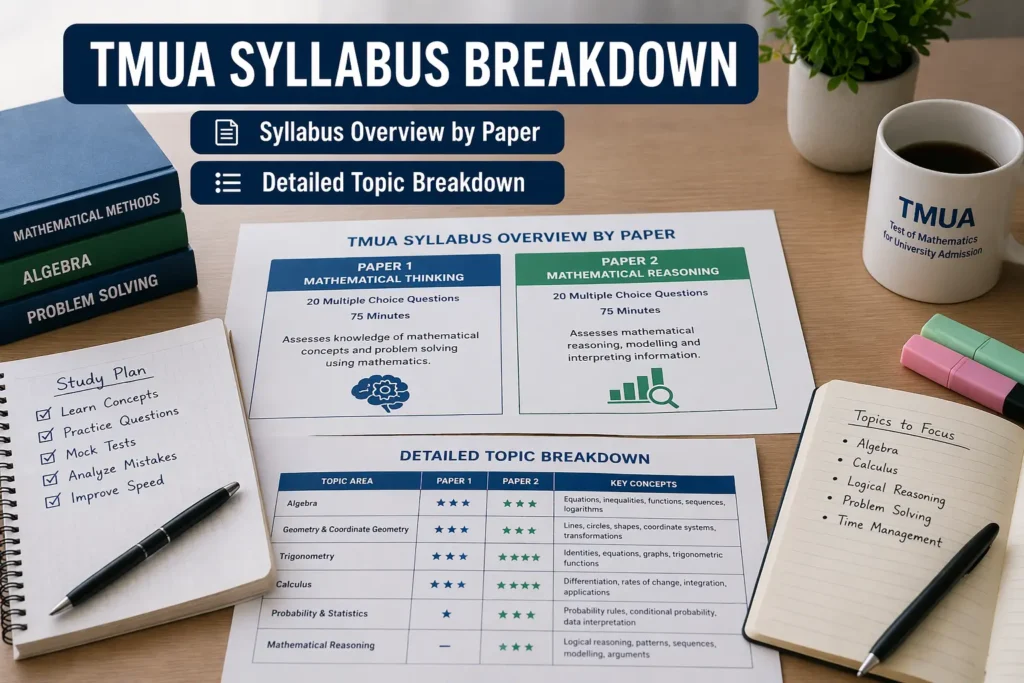
A crucial part of effective TMUA exam preparation is understanding exactly what is on the syllabus. The TMUA tests mathematics at the level of A-Level Mathematics (not Further Mathematics), which means the content is within reach of all students who have studied standard A-Level Maths. The difference lies in how the questions apply and extend that content.
Syllabus Overview by Paper
| Topic Area | Paper 1 | Paper 2 |
|---|---|---|
| Algebra & Functions | Yes | Yes |
| Sequences & Series | Yes | Yes |
| Coordinate Geometry | Yes | Yes |
| Trigonometry | Yes | Yes |
| Exponentials & Logarithms | Yes | Yes |
| Calculus (Differentiation) | Yes | Yes |
| Calculus (Integration) | Yes | Yes |
| Proof | Yes | Yes |
| Statistics & Probability | No | Yes |
| Mechanics | No | Yes |
| Logical Reasoning | Yes | Yes |
Detailed Topic Breakdown
Algebra and Functions
This is the foundational topic area for both papers and carries significant weight throughout. You must be completely fluent in: manipulating algebraic expressions and equations, solving simultaneous equations (linear and non-linear), working with inequalities, understanding and applying function notation, composite and inverse functions, graph transformations (translations, reflections, stretches), and polynomial and rational functions.
The TMUA frequently tests algebra in disguised forms — where a problem appears to be about something else entirely (geometry, sequences, calculus) but the core skill required is algebraic manipulation. Fluency here is non-negotiable.
Sequences and Series
You should be comfortable with arithmetic and geometric sequences and series, including the use of sigma notation. The TMUA also tests understanding of the conditions for convergence of geometric series and applications of sequences in modelling contexts. Questions in this area often require you to recognise patterns and reason about general terms, rather than simply apply a formula.
Coordinate Geometry
This topic covers equations and properties of straight lines, circles, and conic sections. You must understand how to derive equations, find intersection points, calculate distances and midpoints, and understand the geometric interpretation of algebraic conditions. The TMUA particularly favours questions that combine coordinate geometry with algebraic reasoning.
Trigonometry
All standard trigonometric identities, equations, and graphs are in scope. This includes: sine rule and cosine rule, double angle formulae, addition formulae, the relationship between degrees and radians, solving trigonometric equations in given intervals, and the behaviour of inverse trigonometric functions. Trigonometry questions in the TMUA often appear alongside calculus or coordinate geometry.
Exponentials and Logarithms
You must know the properties of exponential and logarithmic functions, including their graphs, domains, and the laws of logarithms. The TMUA tests your ability to solve equations involving exponentials and logarithms, and to model growth and decay mathematically. Questions may also combine this topic with calculus.
Calculus — Differentiation
Differentiation is one of the most heavily tested areas of the TMUA. You must be able to differentiate a wide range of functions including polynomials, trigonometric functions, exponentials, logarithms, and composite functions using the chain rule, product rule, and quotient rule. You must also be able to apply differentiation to find stationary points, determine the nature of those points, and solve optimisation problems.
Calculus — Integration
Integration appears in both papers and demands a solid understanding of both definite and indefinite integration. You must be comfortable with standard integrals, integration by substitution, and the computation of areas under curves and between curves. The TMUA tests not only procedural integration skill but also the conceptual understanding of what integrals represent.
Proof
Mathematical proof is particularly important in Paper 2. You should understand and be able to use the following types of proof: proof by deduction, proof by exhaustion, proof by contradiction, and disproof by counterexample. You will need to evaluate the validity of mathematical arguments and identify errors in reasoning — skills that go significantly beyond the standard A-Level proof curriculum.
Statistics and Probability (Paper 2 Only)
Paper 2 includes questions on basic probability, including conditional probability and Bayes’ theorem. You should understand probability distributions (particularly the binomial distribution), expected value and variance, and be able to interpret statistical claims critically. A key skill tested in Paper 2 is the ability to evaluate whether a statistical conclusion is valid given the data presented.
Mechanics (Paper 2 Only)
Basic mechanics concepts from A-Level Mathematics appear in Paper 2. This includes kinematics (equations of motion), Newton’s laws, forces and equilibrium. The TMUA mechanics questions are generally not the most complex in the paper but reward students who have studied the topic thoroughly.
Logical Reasoning (Both Papers)
Logical reasoning underpins the entire TMUA but is explicitly tested in both papers. This includes: understanding and using mathematical notation precisely, evaluating the logical structure of arguments, identifying necessary and sufficient conditions, and working with quantifiers (for all, there exists). Many students find this area unfamiliar because it is not explicitly taught in A-Level classrooms. Dedicated practice is essential.
Preparation tip: Do not assume that because a topic is in the A-Level syllabus, you already know it well enough for the TMUA. The exam applies familiar content in unfamiliar, high-pressure ways. Always test yourself under timed conditions on each topic before moving on. |
4. The 3–6 Month TMUA Preparation Strategy
Effective TMUA exam preparation is not simply about revising A-Level content. It requires a targeted, structured approach that builds mathematical fluency, develops reasoning skills, improves exam technique under time pressure, and identifies and addresses individual weaknesses systematically. The following strategy is designed to be adapted based on your starting point and the time you have available.

Your 6-Month Study Plan
| Month | Focus Area | Weekly Hours | Milestones |
|---|---|---|---|
| Month 1 | Syllabus mastery – Pure Maths core | 8–10 hrs | Complete A-Level review; identify weak topics |
| Month 2 | Syllabus mastery – Statistics & Proof | 8–10 hrs | First past paper attempt; benchmark score |
| Month 3 | Question-type drills & speed work | 10–12 hrs | Improve time per question below 3 minutes |
| Month 4 | Full past papers under timed conditions | 10–12 hrs | Consistent 5.0+ on mock papers |
| Month 5 | Targeted revision of weak topics | 12–14 hrs | Score 6.0+ on 3 consecutive papers |
| Month 6 | Final consolidation & exam simulation | 8–10 hrs | Full exam simulation with review; rest week before exam |
Phase 1 (Months 1–2): Building the Foundation
Step 1: Baseline Assessment
Before you do anything else, sit a full TMUA past paper under timed conditions. Do not look at any preparation materials beforehand. The goal is to get an honest, unvarnished view of where you currently stand. Score the paper, note every topic you struggled with, and record how many questions you were unable to complete within the time limit.
This baseline score is not a judgment — it is data. It tells you where your preparation needs to focus and gives you a reference point against which to measure your progress.
Step 2: Systematic Syllabus Review
Work through each topic area listed in Section 3 of this guide methodically. For each topic, begin by reviewing your A-Level notes or textbook to refresh your knowledge of the theory. Then immediately move to practice questions — not A-Level exam questions, but TMUA-style questions that require you to apply the topic in non-standard ways.
Spend roughly three to four sessions per topic, and resist the temptation to move on until you feel genuinely confident. A topic that you find easy is one you can review quickly; a topic that challenges you deserves more time.
Step 3: Mental Arithmetic and Calculator-Free Computing
Since calculators are not permitted, you must rebuild comfort with arithmetic. Practise simplifying fractions, computing square roots and cube roots, evaluating trigonometric functions at standard angles, and performing multi-step calculations mentally. Set aside 10–15 minutes per day specifically for mental arithmetic drills. This discipline pays dividends not just in accuracy but in speed.
Phase 2 (Months 3–4): Building Speed and Reasoning
Step 4: Timed Question Sets
Once you have reviewed the syllabus systematically, shift your focus to timed practice. Work through sets of 10 questions with a strict time limit of 30–35 minutes. After each set, review every question — including the ones you got right. Understanding why your correct answer was correct is as important as understanding why your incorrect answers were wrong.
Step 5: Paper 2 Reasoning Practice
Paper 2 deserves dedicated, separate preparation. The reasoning skills it demands — evaluating proofs, identifying logical errors, interpreting statistical arguments — are not developed simply by revising mathematical content. You need to practise thinking about mathematics as a language and a system of argument.
Spend at least two sessions per week on Paper 2 material specifically. Use TMUA past papers, STEP I questions (which develop similar reasoning skills), and AEA (Advanced Extension Award) questions to build the critical mathematical thinking that Paper 2 demands.
Step 6: Full Paper Practice
From Month 3 onwards, begin sitting full mock exams under realistic conditions. This means both papers in a single session, strictly timed, in a quiet environment, without any reference materials. After each mock, carry out a thorough post-exam review: analyse every error, categorise mistakes by type (topic knowledge, reasoning, time pressure, careless errors), and adjust your study plan accordingly.
Phase 3 (Months 5–6): Refinement and Peak Performance
Step 7: Targeted Weakness Elimination
By Month 5, your mock exam data should clearly show you which topics and question types are still costing you marks. Focus the majority of your remaining preparation time on these areas. It is common at this stage to discover that a few specific weaknesses account for the majority of lost marks — eliminating them can produce significant score improvements.
Step 8: Exam Technique Refinement
In the final weeks before the exam, focus on technique as much as content. Develop a consistent approach to each question: read carefully, identify the key mathematical idea being tested, estimate the answer before computing, check your answer by substitution where possible. Learn to flag questions you are unsure about and return to them rather than getting stuck.
Practice strategic guessing on multiple-choice questions. Since there is no negative marking, leaving a question blank is always worse than making an educated guess. By eliminating obviously wrong answers, you can frequently narrow five options to two or three, significantly improving your odds.
Step 9: The Final Week
In the final week before the exam, do not attempt to learn new material. Focus entirely on maintaining confidence and sharpness. Review your notes, revisit a couple of past papers without intense self-scrutiny, and ensure you are well-rested. Sleep, nutrition, and mental state on exam day have a measurable impact on performance.
Rest is revision. The night before the TMUA, review your key formulae, get a full night’s sleep, and arrive at the exam centre with time to spare. Performance under pressure is undermined by anxiety and fatigue — managing these is itself part of your preparation strategy.
Recommended Resources
- TMUA Official Past Papers and Mark Schemes (available from the Admissions Testing Service website)
- A-Level Mathematics textbooks for topic review (Edexcel, AQA, OCR editions all cover the required content)
- STEP I past papers (particularly for Paper 2 reasoning practice)
- Advanced Extension Award (AEA) past papers
- Underground Mathematics (underground.maths.org) — excellent for non-standard problem-solving practice
- NRICH Mathematics (nrich.maths.org) — challenging problems with a reasoning focus
- Isaac Physics — useful for mechanics and applied mathematics questions
5. Common Mistakes to Avoid
Over years of university admissions preparation, a consistent set of errors emerges among students who underperform on the TMUA relative to their actual ability. Understanding these mistakes in advance gives you the opportunity to avoid them entirely.
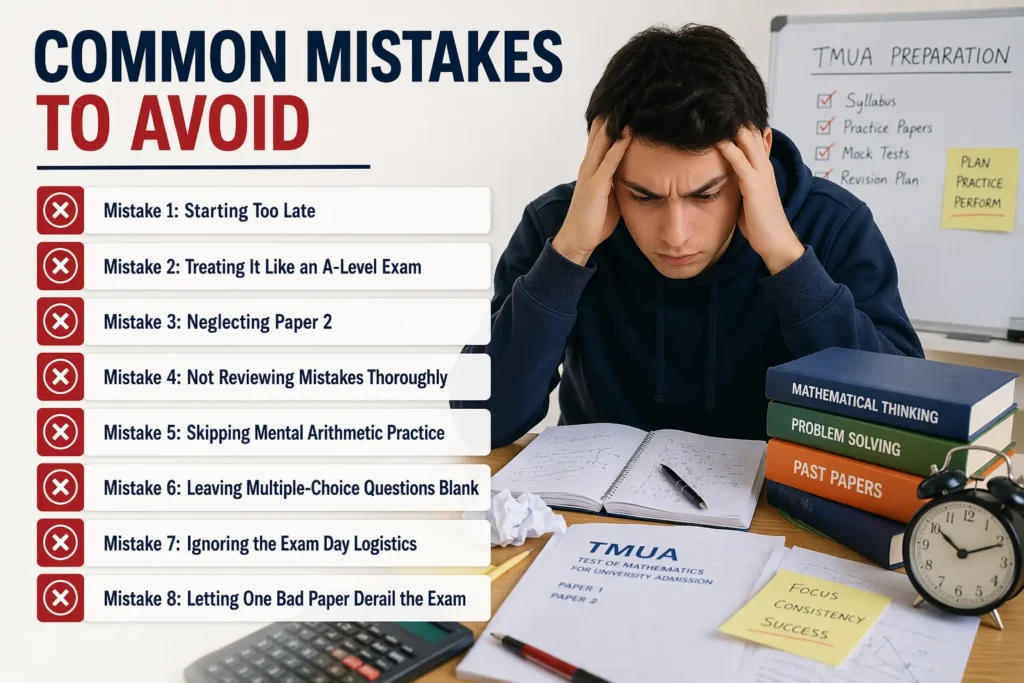
Mistake 1: Starting Too Late
This is the single most common and most damaging mistake. The TMUA is not an exam you can cram for in the week before. The reasoning skills tested in Paper 2, in particular, take weeks of consistent practice to develop. Students who begin preparation in September — just weeks before the October exam — almost always underperform.
The ideal start time for TMUA preparation is April or May of your Year 13 (or equivalent). Six months is optimal. Even if you are reading this guide with less time available, begin immediately and follow an accelerated version of the plan above.
Mistake 2: Treating It Like an A-Level Exam
The TMUA is not an A-Level exam, and preparing for it as if it were is a serious strategic error. A-Level preparation emphasises comprehensive content coverage, extended written responses, and the use of calculators. TMUA preparation emphasises rapid, accurate reasoning, mental arithmetic, multiple-choice strategy, and the ability to apply concepts in unfamiliar contexts.
If your preparation consists primarily of revising A-Level content from textbooks without ever practising TMUA-style questions under time pressure, you will be underprepared regardless of how well you know the material.
Mistake 3: Neglecting Paper 2
Many students focus heavily on Paper 1 because its mathematical knowledge content feels more familiar, and neglect Paper 2. This is a significant mistake. Paper 2 is weighted equally, and the reasoning and logical thinking skills it demands are not intuitive for most students. They must be developed through deliberate, specific practice.
Furthermore, many universities — including Cambridge — pay particular attention to Paper 2 performance as an indicator of mathematical maturity and the kind of thinking required at degree level. A strong Paper 2 score can be highly influential.
Mistake 4: Not Reviewing Mistakes Thoroughly
Getting a question wrong in a practice session is only useful if you understand precisely why you got it wrong. Many students mark their papers, note the score, and move on. This approach wastes the most valuable learning opportunity that practice provides.
After every practice session, spend as long reviewing your errors as you spent completing the questions. For each wrong answer, identify: which topic it tested, what mistake you made (knowledge gap, reasoning error, misread question, arithmetic mistake), and what you should do differently next time. Keep a mistake log and return to it regularly.
Mistake 5: Skipping Mental Arithmetic Practice
Without a calculator, your mental arithmetic must be reliable and efficient. Students who have relied heavily on calculators throughout their A-Level studies often find this a significant challenge. Basic operations that should take seconds — simplifying surds, evaluating trigonometric expressions at standard angles, computing powers — become bottlenecks under time pressure.
Build mental arithmetic practice into your daily routine from the very beginning of your preparation. Even 15 minutes per day of dedicated arithmetic drills, over six months, produces remarkable improvements in speed and confidence.
Mistake 6: Leaving Multiple-Choice Questions Blank
There is no negative marking on the TMUA. Every blank answer is a missed opportunity. Even if you are completely uncertain about an answer, you should always select one of the five options. By eliminating clearly wrong answers through process of elimination, you can often narrow your choice to two or three options, giving yourself a much better chance than random guessing would suggest.
Develop the habit of always answering every question. If you are running out of time at the end of a paper, spend your final 30 seconds filling in answers to any questions you have not yet attempted.
Mistake 7: Ignoring the Exam Day Logistics
The TMUA is administered at authorised test centres, and registration must be completed by the specified deadline — typically in September. Students who miss the registration deadline cannot sit the exam that year. Ensure you register well in advance, confirm your exam centre and date, and know exactly what identification you need to bring.
Additionally, if you have a specific access arrangement (extra time, a reader, or other accommodation), you must apply for this through your school or test centre within the relevant deadline. These arrangements are not applied automatically.
Mistake 8: Letting One Bad Paper Derail the Exam
On exam day, you will sit Paper 1 first, followed by Paper 2. If Paper 1 feels unexpectedly difficult, there is a natural temptation to dwell on this during the break and approach Paper 2 with anxiety. Resist this temptation entirely.
Each paper is marked independently. A difficult Paper 1 may simply mean that the entire cohort found it difficult, which will be reflected in the scaled scoring. Your job in Paper 2 is to perform to the best of your ability, regardless of how Paper 1 felt. Compartmentalise, reset, and focus.
6. Target Scores for Top Universities

One of the most common questions students ask is: what score do I need? While no university publishes a single definitive cut-off score, there is enough publicly available data from past admissions cycles to paint a reliable picture. The following guidance is based on the best available information for the 2026 admissions cycle.
| University / Course | Minimum Score | Competitive Score | Notes |
|---|---|---|---|
| Cambridge – Mathematics | 6.5+ | 7.0+ | TMUA essential; replaces STEP shortlisting |
| Cambridge – Economics | 6.0+ | 6.5+ | High weight in shortlisting |
| LSE – Mathematics & Economics | 5.5+ | 6.0+ | Used alongside grades |
| Imperial – Mathematics | 5.0+ | 6.0+ | Considered with interview |
| Durham – Mathematics | 4.5+ | 5.5+ | Lower threshold but boosts chances |
| Warwick – Mathematics | 5.0+ | 6.0+ | Some courses require TMUA |
| Bath – Mathematics | 4.5+ | 5.5+ | Helps in competitive years |
Cambridge: The Highest Bar
The University of Cambridge is the most selective TMUA-requiring institution and uses the exam most explicitly in its admissions process. For Mathematics and related courses, a score of 6.5 or above substantially increases the likelihood of receiving an interview invitation. Scores of 7.0 and above place you among the strongest applicants nationally.
Cambridge uses TMUA scores as part of a holistic review that also includes your school’s predicted grades, your personal statement, and (if invited) your interview performance. However, the TMUA serves as an important shortlisting tool before interviews are offered. A score below 5.0 at Cambridge is unlikely to lead to a positive outcome, even for candidates who are strong in other respects.
For Economics at Cambridge, the TMUA carries similarly high weight. Scores of 6.0 and above are generally considered competitive, with 6.5 or above placing applicants in a strong position.
LSE: Rigorous but Holistic
LSE does not publish precise TMUA cut-off scores, but applicants to Mathematics and Statistics, Mathematics & Economics, and related programmes should aim for a score of at least 5.5, with 6.0 or above being genuinely competitive. LSE admissions tutors have indicated that the TMUA is an important component of the assessment, used alongside other application materials.
Given the extremely competitive applicant pool at LSE — where many applicants hold predicted A*A*A or equivalent — a strong TMUA score of 6.0 or above can be the differentiating factor that leads to an offer.
Warwick: Course-Specific Variation
At Warwick, TMUA requirements vary by course. Students applying to MORSE (Mathematics, Operational Research, Statistics and Economics), Data Science, and some Mathematics programmes should expect the TMUA to carry significant weight. A score of 5.0 is typically considered a minimum, while 6.0 or above provides a competitive advantage.
Imperial: Supporting Evidence
Imperial College London uses TMUA as part of a broader assessment rather than as a primary hurdle. A score of 5.0 or above demonstrates mathematical aptitude and will strengthen an application. Scores of 6.0 and above are particularly impactful. Given that many Imperial applicants also sit MAT (Mathematics Admissions Test) for some courses, check the specific requirements for your chosen course carefully.
Other Universities: Raising Your Floor
For universities such as Durham, Bath, Lancaster, and Cardiff, the TMUA functions as additional supporting evidence rather than a primary admissions filter. Even so, a score of 5.5 or above will strengthen your application meaningfully, particularly in competitive years or when your predicted grades are similar to those of other applicants.
If you are a borderline candidate at any of these institutions — perhaps with predicted grades at the lower end of their stated requirements, or with a personal statement that is not particularly distinguished — a strong TMUA score can be the factor that tips the admissions decision in your favour.
Remember: the TMUA score you achieve is not just a threshold to clear — it is an active part of your application narrative. A score of 7.0 tells a university something very specific and very positive about the kind of mathematical thinker you are. Aim high, and your score will work for you throughout the admissions process.
When Should You Take the TMUA? (Choosing the Right Sitting)
The TMUA is typically offered more than once in a year. However, the timing of your attempt is extremely important, especially if you are applying to highly competitive universities.
🔑 Key Rule for Cambridge Applicants
If you are applying to the University of Cambridge, you should plan to take the TMUA in the October sitting.
This is because:
- The October sitting aligns with the UCAS application deadline (mid-October)
- Cambridge uses this sitting’s results as part of its shortlisting and admissions process
- Earlier sittings (if available) are generally not used for Cambridge undergraduate admissions decisions
✔️ What This Means for Your Strategy
- Cambridge applicants → Take TMUA in October (essential)
- Do not rely on earlier sittings for your final application score
- Treat any earlier attempt only as practice (if applicable and allowed)
⚠️ Important Note
Different universities may have different policies regarding which TMUA sitting they accept. While Cambridge follows a strict timeline, other universities may be more flexible.
7. Final Thoughts: Making the TMUA Work for You
The TMUA is genuinely challenging, but it is also genuinely learnable. Unlike some aspects of university admissions — where the personal statement is a matter of storytelling, or interview performance can be affected by nerves on the day — the TMUA rewards sustained, structured preparation. Students who invest the time and follow a rigorous preparation strategy consistently perform better than those who do not.

The key mindset to adopt is this: the TMUA is not a test of whether you are clever. It is a test of whether you have thought carefully about mathematics, practised extensively, and learned to reason precisely under time pressure. These are all skills you can develop. They require effort and consistency, but they are within reach.
Begin your preparation early. Follow the structured plan laid out in this guide. Practise with past papers. Review your mistakes thoroughly. Build your mental arithmetic. Pay special attention to Paper 2 reasoning. And approach the exam itself with confidence built on genuine preparation, not wishful thinking.
A score of 6.5 or above is achievable for a well-prepared student. Scores of 7.0 and above are achievable with exceptional preparation. The students who reach these scores are not always the ones with the most natural mathematical talent — they are the ones who prepared most seriously and most strategically.
You now have the knowledge and the framework to do exactly that. The rest is up to you.


Complete Ivy League Admissions Guide for Indian Students (2026): Requirements, SAT, GPA, Essays & Scholarships
Read More »
UCAT Coaching Hyderabad for Medicine UK: Complete Guide to UK Medical School Admissions 2026
Read More »