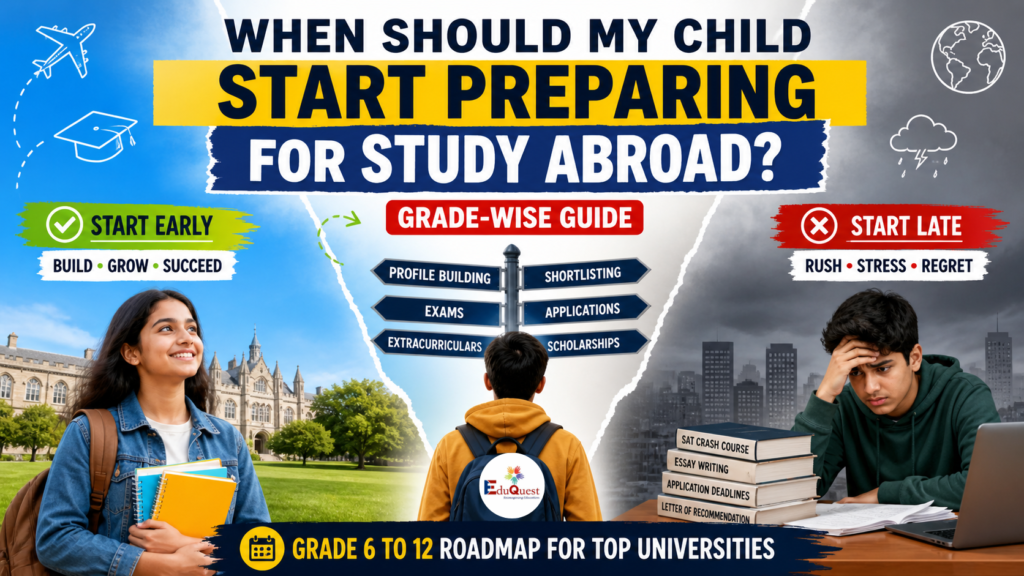
When Should My Child Start Preparing for Study Abroad?
(Grade-wise Guide for 2027–2030 Admissions)
A complete grade-wise roadmap (Class 6–12) covering profile building, standardised exams, extracurriculars, and deadlines for top universities in the US, UK, Canada & Australia.
If you're a parent sitting with this question — Grade 9? Grade 11? Is it already too late? — you are not alone. Every year, thousands of Indian families wake up to the reality of global education only when their child is in Class 11 or 12. And that's when panic sets in.
Here's the truth: the best time to start preparing for study abroad is not when your child is filling out applications — it's years before that. According to research by Seven Corners, 97% of students who study abroad secure employment within a year of graduating, compared to just 49% of all college graduates. But reaching the world's top universities demands more than good grades — it demands years of intentional, strategic preparation.
This grade-wise study abroad preparation timeline will show you exactly what to do — and when — so your child doesn't just apply abroad, but gets accepted into their dream university.
Compared to just 49% of domestic-only graduates. The global edge is real — and it starts with preparation.
Ideal starting point for study abroad preparation: Grade 8–9 for Ivy League and top global universities; Grade 10–11 for strong but less selective universities. Starting in Grade 12 significantly limits scholarship options and profile strength.
Grade-wise Study Abroad Preparation Roadmap (The Core Guide)
Think of your child's study abroad journey as building a skyscraper. The foundation is laid in middle school — and by Grade 12, you're putting the finishing touches on the top floor. Skip the foundation, and the building won't stand.
Here is your complete grade-wise roadmap:
| Grade | Phase | Focus Area | Key Actions |
|---|---|---|---|
| Class 6–8 | Exploration | Curiosity & Foundation | Develop hobbies; join clubs, Olympiads, science fairs; build reading habits; explore coding, arts, or sports; consider international curricula (IB/IGCSE) |
| Class 9 | Profile Building Begins | Extracurriculars & Academics | Start structured profile building; join leadership roles; begin competitive activities; explore PSAT; identify interest areas; consult a study abroad counsellor |
| Class 10 | Deepening Commitment | Competitions & Test Awareness | Participate in national/international competitions; consider Pre-AP courses; begin PSAT 10; shortlist potential countries & universities; research scholarship requirements |
| Class 11 | Exam Prep + Impact Work | SAT/ACT, AP Courses, Internships | Begin SAT/ACT preparation; enrol in AP courses; pursue a meaningful internship or research project; draft initial college list; attend college fairs |
| Class 12 | Applications & Essays | University Applications, LORs, Visa | Finalise SAT/IELTS/TOEFL scores; write personal essays & SOPs; request Letters of Recommendation (LORs); submit CommonApp/UCAS; apply for scholarships & education loans; obtain visa |
Grade 6–8: The Exploration Phase (Your Secret Head Start)
Most parents overlook this window entirely — and that's a costly mistake. The middle school years (Class 6–8) are when the seeds of a world-class profile are planted. Top universities like MIT, Stanford, and Oxford do not just want high scorers — they want curious, driven, multi-dimensional students. And that personality is built, not purchased, over years.
What parents should focus on in Class 6–8:
- Encourage genuine hobbies — coding, robotics, creative writing, environmental science, music, debate
- Enrol in Olympiads (Math, Science, English) to build competitive instincts early
- Explore the IB MYP or IGCSE curriculum if your school offers it — these are highly valued by international universities
- Build strong reading and writing habits — the foundation for future application essays
- Introduce the concept of 'study abroad' casually — let your child develop their own aspirations
The IB MYP (Middle Years Programme) is an excellent choice for students in Class 6–10 targeting global universities. It develops critical thinking, research skills, and an international mindset — exactly what Ivy League admissions officers look for.
Class 9: When Serious Study Abroad Preparation Must Begin
Class 9 is the single most important year to begin a structured study abroad preparation timeline. This is when universities start looking. When you apply in Class 12, admissions officers review your entire high school record — and that includes Grade 9.
Here is what you must prioritise in Class 9:
- Consult a professional study abroad counsellor to map out a personalised roadmap based on your child's strengths, interests, and dream universities
- Begin building a student profile: leadership roles, community service, academic competitions, passion projects
- Consider PSAT preparation — strong PSAT scores (especially National Merit status) can unlock significant scholarships in the US
- Start researching universities: What do their student profiles look like? What kind of extracurriculars do they value?
- Explore Pre-AP or AP courses offered by your school
Class 10: Deepening Your Child's Profile and Raising the Stakes
Class 10 is the transition year. Your child's profile must now show consistent, deepening commitment — not scattered activities. This is also when the first real competitive exams enter the picture.
Key priorities in Class 10:
- Participate in recognised national and international competitions (science olympiads, debate, Model UN, math leagues)
- Begin shortlisting countries and universities based on academic interests and career goals
- Explore scholarship requirements early — many scholarships require applications 18–24 months in advance
- Take the PSAT 10 if targeting US universities
- Research whether AP courses or the IB Diploma Programme (DP) is the right fit for Class 11–12
For US university admissions, AP courses signal rigour. For UK and global universities, the IB Diploma is highly respected and provides a holistic credential. EduQuest helps families choose the right curriculum path for their child's target universities.
Class 11: The High-Stakes Year — Exams, Impact, and University Research
Class 11 is where study abroad preparation shifts from gradual to urgent. This is the year your child must simultaneously excel academically, prepare for standardised tests, deepen their profile, and begin the university research process in earnest.
The study abroad preparation timeline for Class 11 should include:
- SAT/ACT: SAT or ACT preparation — ideally take the first attempt by February–March of Class 11
- AP Courses: Begin AP courses and prepare seriously for AP exams (scores of 4–5 are ideal for top US universities)
- Internship/Research: Take on a meaningful internship, research project, or social impact initiative — admissions essays require real, specific experiences
- UK (UCAS): If targeting the UK, begin UCAS research and shortlist courses under the specific 'personal statement by subject' format
- University Shortlisting: Attend university fairs and virtual info sessions to refine your college list
Class 12: The Application Year — Execution, Essays, and Scholarships
Class 12 is not the time to start preparing — it is the time to execute a plan you have been building for years. Students who begin preparation here are not competing on a level playing field.
What Class 12 study abroad preparation must cover:
- Finalise SAT/ACT scores (ideally 1400+ for strong universities, 1500+ for Ivy League). Retake if needed
- Complete IELTS or TOEFL for English proficiency — most universities require 6.5+ IELTS or 90+ TOEFL
- Write compelling personal essays and Statements of Purpose (SOPs) — your story, in your voice
- Request Letters of Recommendation (LORs) from teachers and mentors who know you well — give them 6–8 weeks
- Submit applications via CommonApp (US), UCAS (UK), or direct portals (Canada, Australia)
- Apply aggressively for merit-based scholarships and explore education loan options
- Begin visa application process immediately after receiving offers
Early vs Late Preparation — The Real Cost of Waiting
This is perhaps the most important section of this guide. Let's compare two students — both intelligent, both hardworking — who made one different decision: when to start.
| Factor | Starting Class 8–9 ✓ | Starting Class 11–12 ✗ |
|---|---|---|
| Extracurricular Profile | Deep, consistent, meaningful — leadership across years | Thin or rushed — hard to explain in essays |
| SAT/ACT Scores | Multiple attempts, optimal score achieved | Limited attempts, time pressure |
| AP/IB Courses | 3–5 rigorous courses completed | 1–2 courses, minimal time to excel |
| Essay Quality | Rich, specific experiences to draw from | Generic, lacks depth and authenticity |
| Scholarship Access | Full range of merit scholarships available | Many scholarship deadlines already passed |
| University Choices | Wide range including Ivy League and Top 20 | Limited to less selective institutions |
| Visa & Logistics | Planned and stress-free | Rushed, high risk of errors |
Country-Specific Study Abroad Preparation Timeline
Different countries evaluate students differently. Here's what you need to know about the major study abroad destinations to calibrate your preparation timeline correctly.
Holistic Admissions
Key exams: SAT (1200–1600 scale), AP courses, TOEFL/IELTS for non-native English speakers
Application portal: CommonApp or Coalition App
Early Decision/Action deadlines: November 1–15 | Regular Decision: January 1
Academic Focus
Key exams: A-Levels / IB / CBSE equivalent, IELTS (7.0+), TMUA/BMAT for specific programmes
Application portal: UCAS (max 5 university choices)
UCAS deadline: October 15 (Oxbridge) | January 31 (others)
Balanced Approach
Key exams: IELTS (6.5+) or TOEFL (90+). SAT is not required but may strengthen applications
Application portals vary by province: OUAC (Ontario), BCCAT (BC), direct applications
GPA + English Proficiency
Key exams: IELTS (6.5+), PTE Academic, or TOEFL
Strong ATAR equivalent or CBSE/ISC marks with 70%+ are typically required
6 Common Mistakes Parents Make When Planning Study Abroad
In our years of counselling at EduQuest, we've seen the same patterns derail even the most capable students. Avoid these mistakes:
- Starting too late: Beginning in Class 12 leaves no time to build a genuine profile. Universities see rushed, inauthentic applications immediately.
- Focusing only on marks: Academic excellence is necessary but not sufficient for top global universities. A student with 95% but no extracurriculars is a weaker applicant than a student with 88% and a compelling story.
- Ignoring English proficiency tests: IELTS and TOEFL preparation takes 3–6 months for strong scores. Do not leave these for Class 12.
- Choosing universities based on rankings alone: Fit matters more than rankings. A student passionate about film studies will thrive at NYU Tisch, not necessarily at MIT.
- Underestimating financial planning: Study abroad is an 18–36 month financial journey. Research education loans, scholarships, and living costs well in advance — ideally from Class 9 onwards.
- Not building a 'spike' profile: Top universities prefer students who are exceptionally strong in one or two areas over those who are mediocrely average in ten. Help your child find and deepen their spike.
Expert Insight — What Top Universities Actually Look For
"Top universities evaluate 3–4 years of consistent profile development. A student who has pursued a single passion deeply, demonstrated leadership, and shown intellectual curiosity beyond the classroom is far more compelling than one with a last-minute list of activities. The students we see getting into MIT, Stanford, and Oxford are not the ones who started in Class 12 — they are the ones who started with a question in Class 9 and pursued it relentlessly."
— Senior Counsellor, EduQuest | 15+ Years in International University Admissions
This is what study abroad preparation planning from school level truly means: not drilling for an exam, but building a student who is genuinely ready to thrive in a global environment.
Get a FREE personalised profile evaluation from EduQuest's expert counsellors. We'll tell you exactly what's missing — and how to fix it before application season.
Study Abroad Preparation Checklist by Grade
Use this quick-reference checklist to ensure your child is on track. Check off items as you complete them:
Frequently Asked Questions
Conclusion — The Best Time to Start Was Yesterday. The Second Best Time Is Now.
Study abroad preparation is not a sprint you run in Class 12 — it is a marathon that begins years before the finish line. The students who make it into the world's top universities are not necessarily the most brilliant — they are the most prepared, the most consistent, and the most intentional.
Whether your child is in Class 6 or Class 11, there is a path forward. The question is not whether it's too late — the question is: are you ready to start?
At EduQuest, we have helped hundreds of Indian students gain admission into universities across the USA, UK, Canada, Australia, and Europe — including Ivy League institutions like Yale, Columbia, and UPenn. Our end-to-end study abroad counselling, SAT/AP coaching, IELTS preparation, and profile building programmes are designed to give your child the best possible chance — regardless of which grade they're starting from.
Book a FREE 30-minute consultation with EduQuest's senior counsellors. We'll map out a personalised grade-wise roadmap for your child — completely free, no obligation.