SAT EXAM 2026 SYLLABUS BREAKDOWN
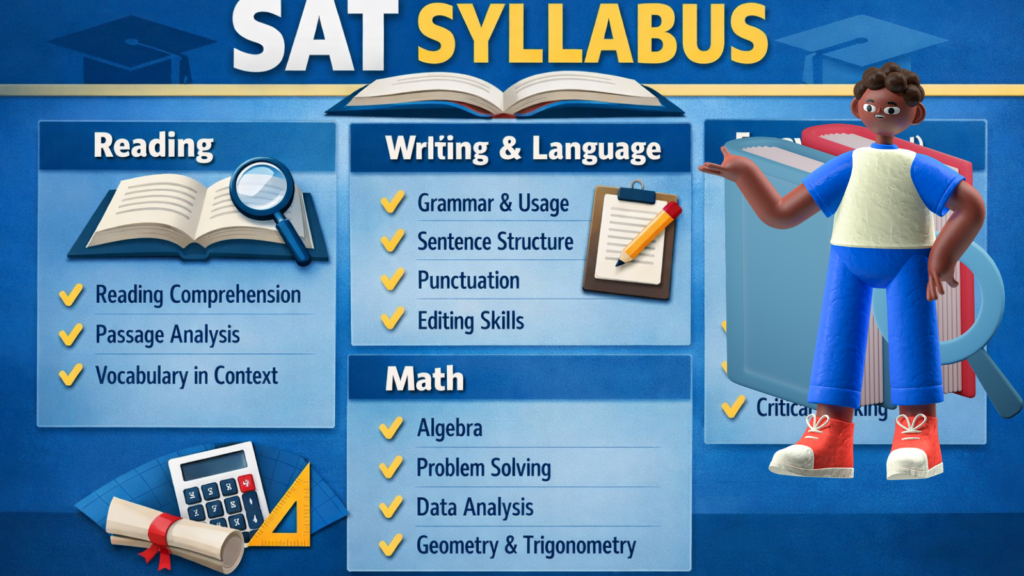
The SAT 2026 syllabus assesses students’ academic skills through a digital, adaptive format that prioritizes real-world application over rote memorization. It consists of two main sections: Reading & Writing and Math. Each section is divided into two adaptive modules, with difficulty adjusting based on performance. Reading & Writing covers comprehension, vocabulary in context, grammar, and analysis of short passages, including Information & Ideas, Craft & Structure, and Standard English Conventions.
The Math section includes algebra, advanced math, problem-solving, data analysis, geometry, and basic trigonometry, with both multiple-choice and student-produced response questions. The exam emphasizes critical thinking, logical reasoning, and practical problem-solving to better reflect academic and career demands.
ABOUT MATH -
ABOUT MATH -
https://eduquest.org.in/sat-2026-seo-cluster-eduquest-growth-engine/
The SAT 2026 Math section tests your ability to solve real-world problems using core mathematical concepts. It focuses on Algebra, Advanced Math (functions and equations), Problem-Solving and Data Analysis, and Geometry with basic Trigonometry. Unlike older versions, the digital SAT allows calculator use throughout the entire Math section, helping solve complex calculations more efficiently.
The questions mix multiple-choice and student-produced responses. Many are based on real-life scenarios like graphs, tables, and word problems. The exam is adaptive, meaning your performance in the first module determines the difficulty of the next one, so starting strong is important.
To score high, students should focus on mastering basic concepts, practicing regularly, and improving accuracy. Topics like linear equations, quadratic functions, percentages, ratios, and data interpretation are especially important. Overall, the SAT 2026 Math section emphasizes logic, application, and problem-solving skills over memorization.
ABOUT READING
ABOUT READING
The SAT 2026 Reading & Writing section tests your ability to understand, analyze, and improve written content in a digital adaptive format. Instead of long passages, it includes short paragraphs (25–150 words) followed by a single question, making it faster and more focused. It combines reading comprehension and grammar skills into one section.
The questions cover areas like main idea, inference, vocabulary in context, tone, and logical structure, along with grammar rules, punctuation, and sentence correction. You may also see questions based on charts, graphs, and short data passages, where you need to connect written information with visual data.
To perform well, students should practice quick reading, strong comprehension, and grammar accuracy. Focus on understanding the author’s intent, identifying correct sentence structure, and logically eliminating wrong answer choices. Since the test is adaptive, doing well in the first module helps you reach harder questions and improve your score. Success in this section depends on clear understanding, attention to detail, and consistent practice.
HIDDEN PATTERNS SAT EXAM 2026
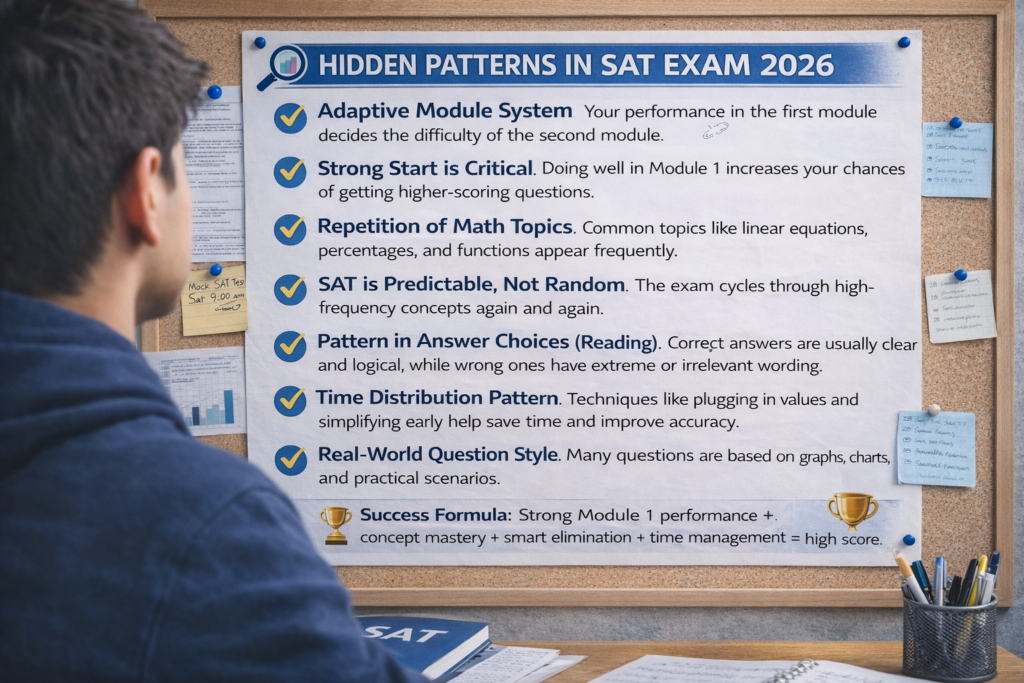
Adaptive Module System
Your performance in the first module determines the difficulty of the second module.
Strong Start is Critical
Doing well in Module 1 increases your chances of receiving higher-scoring questions.
Repetition of Math Topics
Common topics like linear equations, percentages, and functions appear frequently.
Repetition of Reading & Writing Topics
Questions often focus on main idea, inference, and grammar rules.
SAT is Predictable, Not Random
The exam cycles through high-frequency concepts again and again.
Pattern in Answer Choices (Reading)
Correct answers are usually clear and logical; wrong ones have extreme or irrelevant wording.
Pattern in Math Strategy
Techniques like plugging in values and early simplification help save time and improve accuracy.
Time Distribution Pattern
Questions generally start easy and become more difficult as you progress.
Real-World Question Style
Many questions are based on graphs, charts, and practical scenarios.
Success Formula
Strong Module 1 performance + concept mastery + smart elimination + time management = high score.